Göbekli Tepe: The 12,000-Year-Old Mystery Rewriting Human History
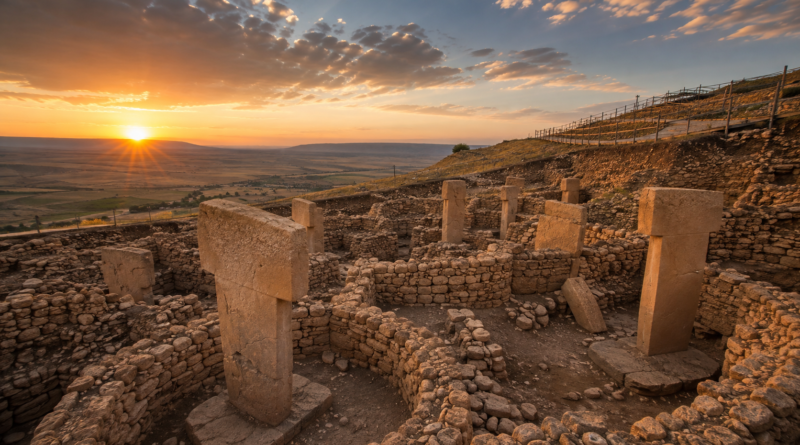
Nearly 12,000 years ago, long before the construction of Stonehenge or Egypt’s great pyramids, prehistoric communities in southeastern Türkiye created one of the most extraordinary archaeological sites ever discovered: Göbekli Tepe.
Its massive T-shaped limestone pillars, mysterious animal carvings, and monumental stone structures have challenged traditional assumptions about how early human societies developed.
But the greatest Göbekli Tepe mystery is not simply how ancient people moved enormous stones without modern technology. It is why communities living during the transition toward agriculture invested so much effort in building these remarkable monuments.
Was Göbekli Tepe an ancient temple, a gathering place, part of a settlement, or something more complex? And what can its architecture reveal about the origins of organized communities, ritual traditions, and monumental construction?
To explore these questions, we need to separate archaeological evidence from popular theories and examine what researchers have actually discovered.
What Is Göbekli Tepe?
Göbekli Tepe is a prehistoric archaeological site located near Şanlıurfa in southeastern Türkiye. Its name means “Potbelly Hill,” referring to the rounded mound that rises above the surrounding landscape.
Beneath that hill, archaeologists uncovered a remarkable collection of monumental stone structures dating to the Pre-Pottery Neolithic period. The principal monumental phases were constructed roughly between 9600 and 8200 BCE, making them thousands of years older than Stonehenge and the pyramids of ancient Egypt.
The site’s most recognizable features are enormous T-shaped limestone pillars arranged within round, oval, and rectangular structures. Some pillars reach approximately 5.5 meters in height.
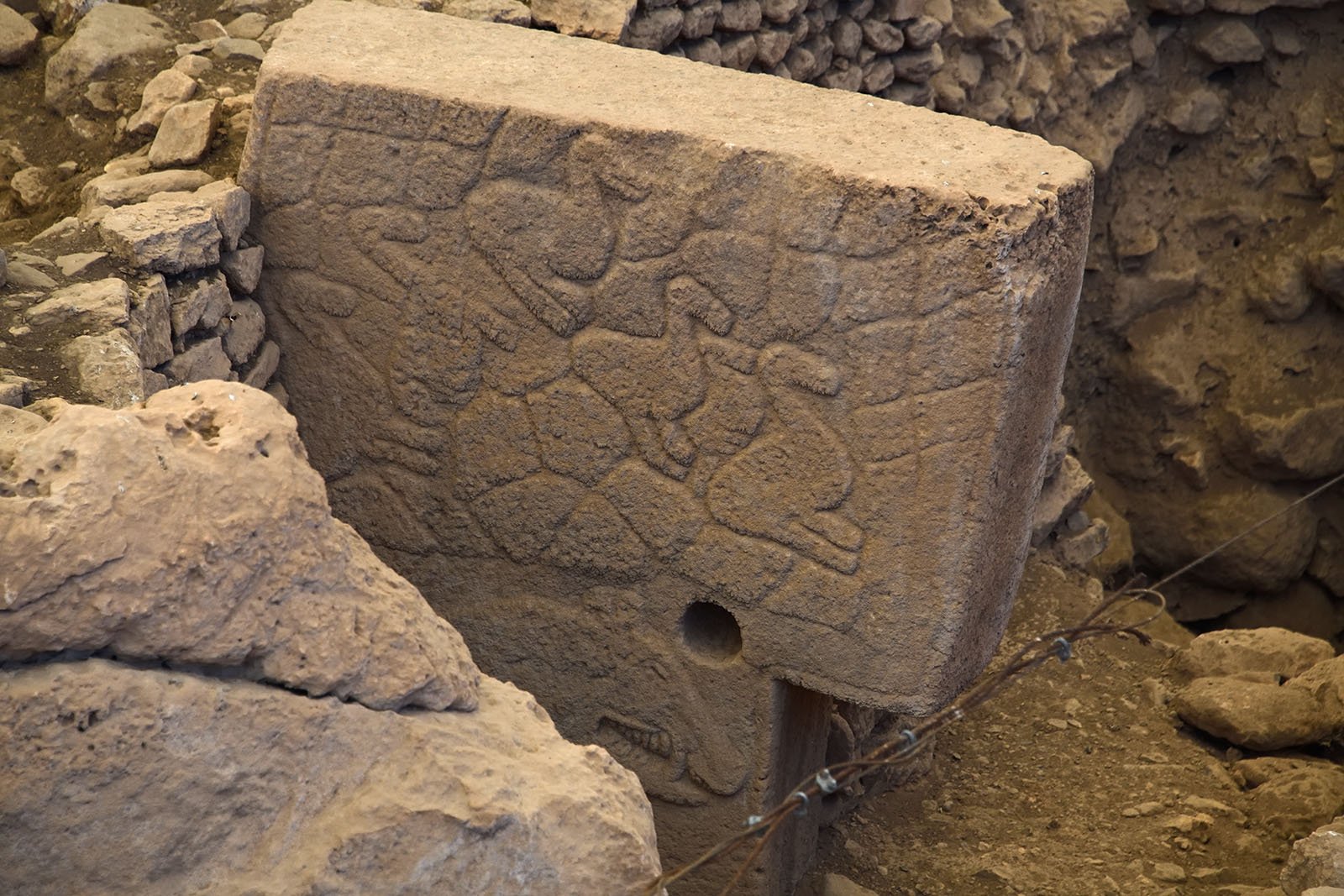
Many are covered with carvings of wild animals, including snakes, foxes, wild boars, birds, and other creatures. Some of the central pillars also display carved arms, hands, belts, and clothing, suggesting that the T-shaped stones may represent highly stylized human figures.
But Göbekli Tepe is more than a collection of ancient stones. It was constructed during one of the most important transitions in human history, when communities across the region were moving toward increasingly settled ways of life and, eventually, agriculture.
How Was Göbekli Tepe Discovered?
Göbekli Tepe was not completely unknown before the famous excavations that transformed our understanding of it.
Archaeologists from Istanbul University and the University of Chicago surveyed the area in the 1960s, but the significance of the mound was not fully recognized at the time. Some of the visible limestone remains were interpreted as belonging to later periods.
The story changed dramatically in the 1990s.
German archaeologist Klaus Schmidt visited the site and recognized that the large limestone fragments scattered across the hill were likely prehistoric. Excavations beginning in 1995 revealed enormous T-shaped pillars and monumental structures unlike anything expected from such an early period.
The discoveries immediately raised difficult questions.
How could communities living at the beginning of the Neolithic organize the labor required to quarry, carve, transport, and erect such massive stones?
And why did they build them?
Those questions transformed Göbekli Tepe from an obscure archaeological mound into one of the most discussed prehistoric sites in the world.
Who Built Göbekli Tepe?
The people who constructed Göbekli Tepe lived during the Pre-Pottery Neolithic, before pottery became widespread in the region and during the transition from hunting and gathering toward increasingly settled communities.
Calling them simply “primitive hunter-gatherers” can therefore be misleading.
Evidence from Göbekli Tepe and other contemporary sites across Upper Mesopotamia reveals communities capable of sophisticated stoneworking, architectural planning, large-scale cooperation, food processing, and complex symbolic expression.
Building the monumental structures would have required people to quarry limestone, shape enormous pillars with stone tools, move them to construction areas, decorate them, and coordinate their placement.
This suggests considerable organization and shared knowledge.
Göbekli Tepe therefore challenges older, overly simple models in which monumental architecture appeared only after fully developed farming villages and complex political societies had already emerged.
What Do the T-Shaped Pillars Represent?
The enormous T-shaped pillars are perhaps the greatest visual mystery of Göbekli Tepe.
At first glance they may appear to be abstract architectural supports. Closer examination reveals something more intriguing.
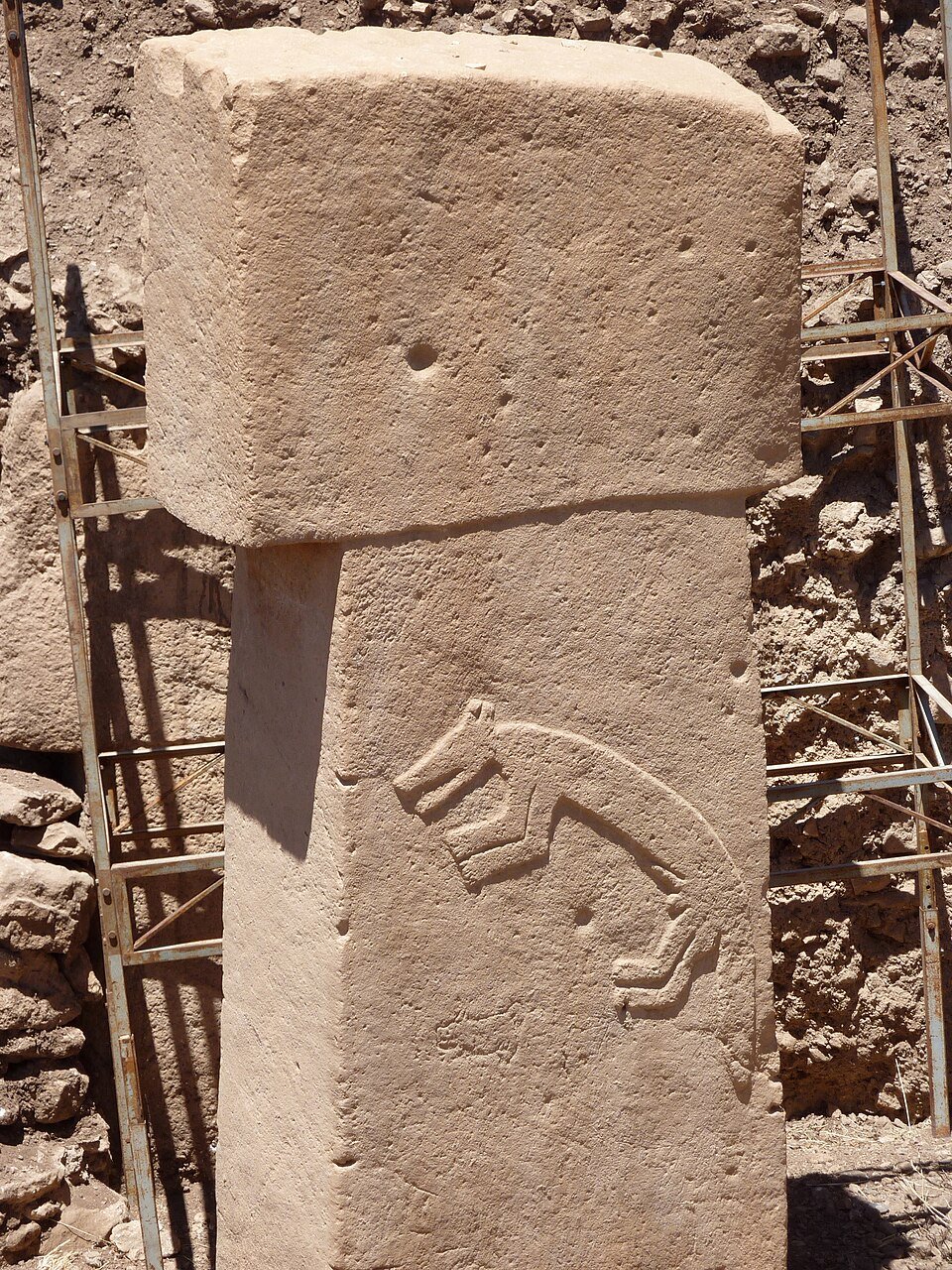
Several central pillars contain carved arms and hands positioned along their sides, while others display belts and garments. These details have led archaeologists to interpret at least some of the pillars as stylized anthropomorphic figures.
Around them appear striking images of wild animals.
Snakes, foxes, boars, birds and other creatures dominate the carved imagery. Rather than depicting a peaceful domesticated environment, the artwork repeatedly emphasizes the wild natural world.
Exactly what these images meant remains unknown.
They could have represented stories, identities, supernatural beings, memories, dangers, social groups, or concepts that have been lost entirely.
Without written records, archaeologists must interpret the imagery through its archaeological context rather than translate it as if it were a written language.
Was Göbekli Tepe Really the World’s Oldest Temple?
Göbekli Tepe is frequently called the “world’s oldest temple.”
It is a powerful description—but it oversimplifies the archaeological evidence.
The monumental structures almost certainly had important communal and symbolic functions. Their architecture, carvings, and unusual scale strongly suggest activities extending beyond ordinary daily life, and ritual gatherings may have played an important role.
However, more recent archaeological work has complicated the older image of Göbekli Tepe as an isolated sanctuary visited only by wandering hunter-gatherers.
Excavations have identified less monumental structures that appear to have been domestic, while research across neighboring prehistoric sites reveals that Göbekli Tepe belonged to a much broader landscape of early settled communities.
For this reason, many archaeologists now prefer terms such as “monumental communal buildings” rather than simply calling every enclosure a temple.
The distinction matters.
Göbekli Tepe remains extraordinary even without the dramatic “first temple” label. Its real importance lies in revealing that monumental architecture, complex symbolism, and organized communal activity existed extremely early in the Neolithic.
Was Göbekli Tepe Designed Using Geometry?
One particularly fascinating line of research concerns the site’s architectural planning.
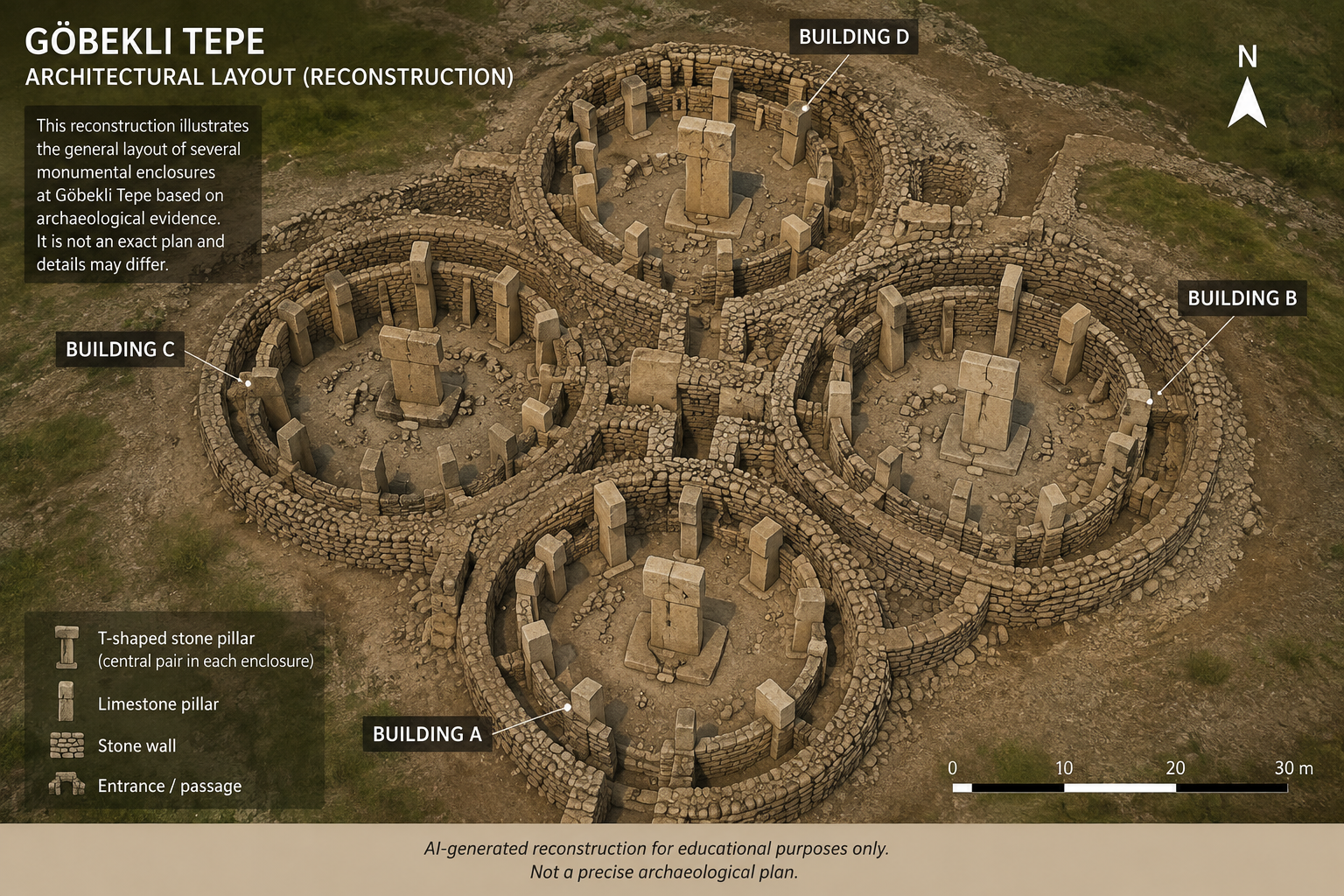
A study published in the Cambridge Archaeological Journal analyzed the spatial arrangement of several monumental enclosures and identified an underlying geometric pattern.
The researchers argued that three large enclosures may have been conceived according to a coherent architectural plan rather than constructed independently without an overall design.
If this interpretation is correct, the builders were capable not only of moving enormous stones but also of applying abstract spatial planning before construction.
That does not mean they possessed modern mathematics.
But it does demonstrate that sophisticated planning and geometric thinking should not automatically be associated only with later urban civilizations.
Did Ancient Earthquakes Affect Göbekli Tepe?
Recent archaeological research has introduced another important question about Göbekli Tepe: could earthquakes have influenced the development and modification of its prehistoric buildings?
A 2024 study published in Archaeological Research in Asia examined architectural damage patterns and potential evidence of seismic activity at the site.
The research explored how early Neolithic communities may have responded to structural damage and environmental hazards through building modifications and other architectural adaptations.
These findings provide an additional perspective on the site’s long architectural history. They suggest that understanding Göbekli Tepe requires examining not only its symbolic carvings and monumental pillars, but also the practical challenges faced by the people who constructed and maintained its buildings.
However, earthquake-related damage does not establish that a single catastrophic event caused the abandonment or burial of Göbekli Tepe. The site’s development involved multiple phases of construction, modification, and filling.
Research source: Shaking up the Neolithic – Archaeological Research in Asia (2024).
Why Was Göbekli Tepe Buried?
One of Göbekli Tepe’s most persistent mysteries concerns what happened to its monumental buildings.
Many of the large enclosures accumulated substantial amounts of fill. Earlier interpretations often described this process as deliberate burial, suggesting that prehistoric communities intentionally filled structures after they were no longer used.
The actual history appears more complicated.
Göbekli Tepe underwent centuries of construction, rebuilding, modification, abandonment, and filling. Some structures were altered repeatedly, and the mound itself developed through long-term human activity.
Intentional backfilling may have occurred in particular contexts, but it is risky to imagine a single dramatic event in which the entire site was deliberately buried at once.
Why individual structures were closed or filled remains uncertain.
Changes in social practices, rebuilding programs, shifting settlement patterns, or changing communal traditions may all have played roles.
Did Göbekli Tepe Change the History of Civilization?
You will often encounter the claim that Göbekli Tepe “rewrote human history.”
That statement contains some truth, but it needs context.
Older simplified narratives sometimes imagined a straightforward sequence: humans began farming, permanent villages appeared, populations grew, and only afterward did organized religion and monumental architecture develop.
Göbekli Tepe demonstrates that reality was considerably more complicated.
Large communal construction projects and sophisticated symbolic traditions existed during the transition toward settled agricultural life, rather than simply appearing at the end of that process.
Göbekli Tepe does not prove that religion single-handedly created agriculture, nor does it show that an unknown advanced civilization existed before recorded history.
Instead, it reveals something arguably more interesting: early Neolithic societies were capable of levels of cooperation, planning, craftsmanship, and symbolic expression that archaeologists once underestimated.
What Mysteries Remain?
Despite decades of excavation, Göbekli Tepe still leaves many fundamental questions unanswered.
We do not know precisely what every monumental structure was used for.
We cannot translate the animal imagery with certainty.
We do not know exactly what the central anthropomorphic pillars represented or whether they depicted ancestors, supernatural beings, important individuals, or something else entirely.
Nor do we fully understand the relationship between everyday domestic life and the extraordinary communal architecture.
Future excavation may answer some of these questions.
Others may remain permanently beyond our reach because the people who built Göbekli Tepe left no known written explanation of their world.
That uncertainty is precisely what makes the site so compelling.
Quick Facts
- Location: Near Şanlıurfa, southeastern Türkiye
- Period: Pre-Pottery Neolithic
- Main monumental phases: Approximately 9600–8200 BCE
- Age: More than 11,000 years
- Famous features: Monumental T-shaped limestone pillars
- Maximum pillar height: Approximately 5.5 meters
- Carvings: Snakes, foxes, wild boars, birds and other animals
- Excavations began: 1995
- Key archaeologist: Klaus Schmidt
- UNESCO World Heritage Site: Since 2018
- Original purpose: Still debated
- “World’s oldest temple”?: Popular description, but an oversimplification of current archaeological interpretation
Frequently Asked Questions
How old is Göbekli Tepe?
The main monumental structures at Göbekli Tepe date approximately from 9600 to 8200 BCE, making the site more than 11,000 years old and several millennia older than Stonehenge and Egypt’s famous pyramids.
Who built Göbekli Tepe?
Göbekli Tepe was built by Pre-Pottery Neolithic communities living in Upper Mesopotamia during the transition from hunter-gatherer lifeways toward increasingly settled communities and early agriculture.
Is Göbekli Tepe older than Stonehenge?
Yes. Göbekli Tepe’s monumental structures began appearing thousands of years before the major stone phases of Stonehenge.
Is Göbekli Tepe older than the Egyptian pyramids?
Yes. Göbekli Tepe’s earliest monumental structures predate Egypt’s Old Kingdom pyramids by several thousand years.
Was Göbekli Tepe a temple?
Possibly, but describing the entire site simply as a temple is controversial. Its monumental buildings likely had communal and ritual significance, while archaeological evidence also indicates domestic activity at the site.
Why are the pillars shaped like a T?
The exact reason is unknown. Carved arms, hands, belts, and clothing on some pillars indicate that at least some T-shaped pillars probably represented stylized human-like figures.
Why was Göbekli Tepe buried?
Some monumental structures accumulated intentional fill, but the site’s history involved centuries of rebuilding, modification, filling and abandonment. Archaeologists cannot reduce the process to one proven event or motive.
What makes Göbekli Tepe so important?
Göbekli Tepe demonstrates that early Neolithic communities were capable of monumental construction, sophisticated artistic symbolism, organized cooperation, and architectural planning at an unexpectedly early point in human history.
Conclusion
Göbekli Tepe is extraordinary not because it proves the existence of a forgotten advanced civilization, but because the people who actually built it were far more capable and socially complex than older stereotypes of early hunter-gatherers suggested.
More than 11,000 years ago, communities in Upper Mesopotamia quarried enormous limestone pillars, decorated them with remarkable imagery, organized monumental construction projects, and created spaces whose meanings still challenge archaeologists today.
Research has also transformed the way we understand the site itself. The once-popular image of an isolated “world’s oldest temple” has given way to a richer picture involving monumental communal buildings, domestic activity, changing architecture, and a wider network of early Neolithic settlements.
Many questions remain unanswered.
And that may be the most fascinating thing about Göbekli Tepe: every discovery makes the ancient world a little clearer while revealing just how much we still do not know.
Continue Exploring Ancient Mysteries
- The Antikythera Mechanism: The Ancient Computer That Shouldn’t Exist
- The Baghdad Battery: Was Ancient Electricity Real?
- Hidden Ancient Cities Beneath Egypt’s Sands: Discoveries That Changed History
Sources
UNESCO World Heritage Centre — Göbekli Tepe
Cambridge Archaeological Journal — Geometry and Architectural Planning at Göbekli Tepe