The Lost Byzantine City of Dakhla Oasis: Egypt’s 1,600-Year-Old Desert Discovery
Introduction
In July 2026, Egyptian archaeologists announced a remarkable discovery at Ain El-Sabil in Dakhla Oasis, deep within Egypt’s Western Desert: an exceptionally well-preserved residential settlement dating to the fourth century CE.
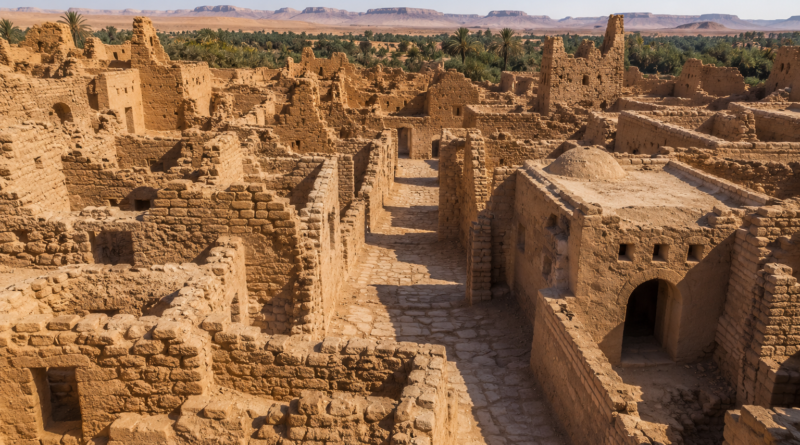
The approximately 1,600-year-old Byzantine settlement reveals how an organized community lived far from the Nile Valley. Excavations uncovered mud-brick houses, carefully planned streets, defensive watchtowers, food-production facilities, and a Christian basilica.
Among the most significant finds were approximately 200 inscribed pottery fragments, known as ostraca, containing texts in Greek and Coptic. These documents offer valuable evidence of commercial transactions, correspondence, and everyday activities.
Archaeologists also recovered bronze and gold coins, pottery vessels, oil lamps, and tools used in food preparation and grain processing.
What makes this discovery particularly important is not simply the age of the buildings. It is the combination of architecture, written records, religious structures, and household objects that allows researchers to investigate daily life in Byzantine-era Egypt.
So what exactly did archaeologists uncover at Ain El-Sabil, and what does the settlement reveal about life in Egypt’s Western Desert 1,600 years ago?
What Was Discovered in Dakhla Oasis?
The discovery was made at the archaeological site of Ain El-Sabil in Dakhla Oasis, part of Egypt’s New Valley Governorate.
Rather than uncovering a single monument or isolated building, archaeologists revealed an extensive residential settlement containing many of the elements necessary for an organized community.
Its architecture was constructed primarily from mud brick, a material particularly well suited to Egypt’s dry desert environment.
The settlement followed a carefully organized urban plan. Major streets ran roughly north to south and were crossed by east-west routes, creating open spaces and squares between different parts of the community.
Archaeologists identified residential buildings with large reception halls and vaulted roofs, along with bread ovens, kitchens and stone installations used to grind grain.
The settlement also contained substantial defensive architecture, including the remains of two watchtowers positioned around its outskirts and a heavily fortified structure with thick walls.
At the center of this complex picture of domestic, defensive and religious life stood a Christian basilica dating to around the middle of the fourth century CE.
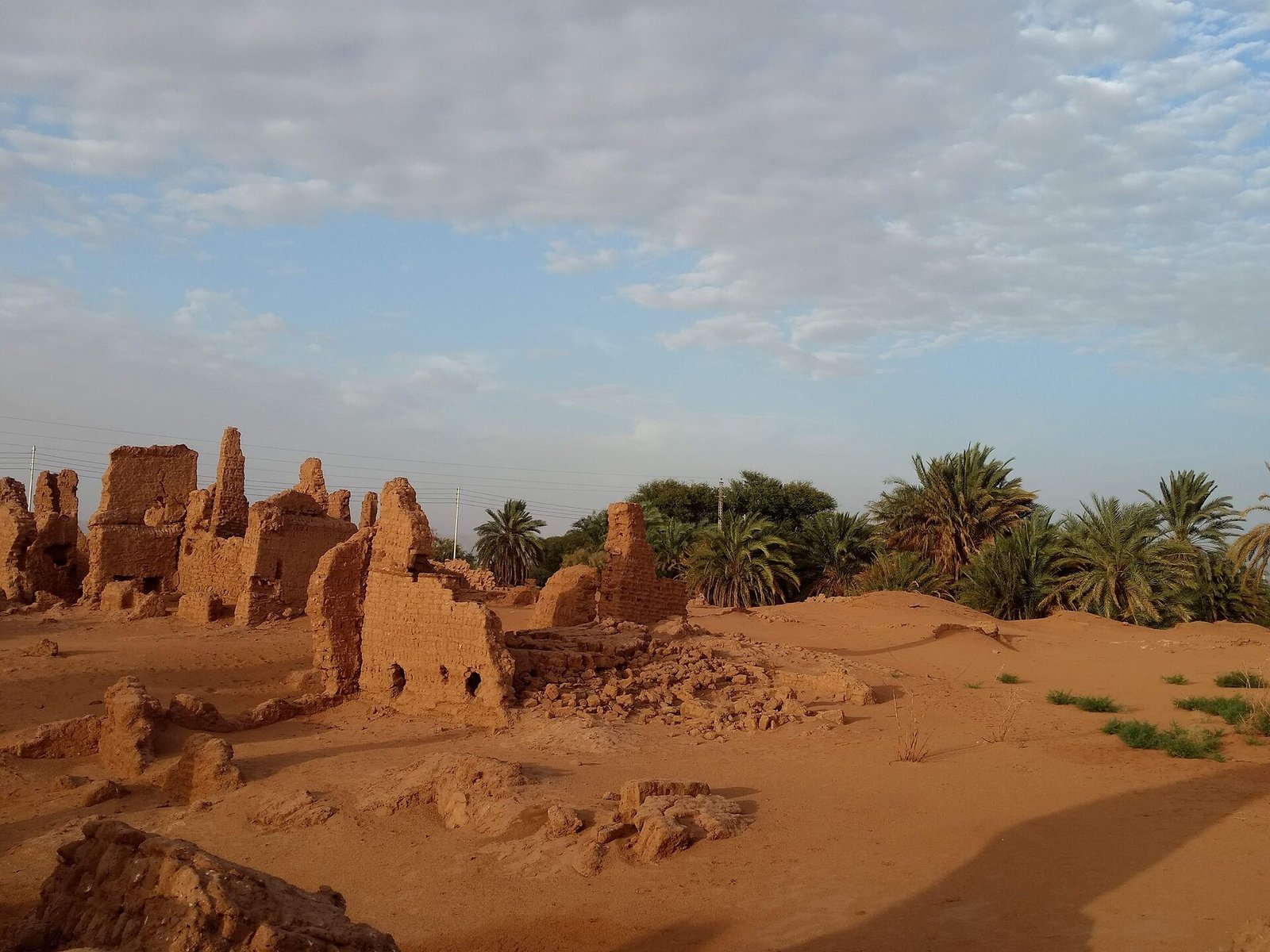
Image credit: M. Gamal Saleh via Wikimedia Commons — CC BY-SA 4.0. Image shows Balat in Dakhla Oasis, not the Ain El-Sabil excavation.
Where Is the Ancient Settlement?
Dakhla Oasis lies deep within Egypt’s Western Desert, hundreds of kilometers from the Nile Valley.
Today it forms part of the New Valley Governorate, but the oasis has supported human communities for thousands of years because its natural water resources made agriculture and permanent settlement possible in an otherwise extremely arid landscape.
The newly highlighted Byzantine settlement is located at Ain El-Sabil, an archaeological site already known to researchers before the 2026 announcement.
Its remote location should not be mistaken for isolation.
Oasis communities could participate in networks connecting the Western Desert with the Nile Valley and other settlements. The artifacts and written records discovered at Ain El-Sabil provide researchers with evidence for the economic, religious and social lives of people living far beyond Egypt’s major river cities.
The Dakhla Oasis Byzantine City provides rare archaeological evidence of how an organized community developed within this remote desert environment.
A 1,600-Year-Old Community Built From Mud Brick
One of the most striking aspects of Ain El-Sabil is how much information survives about the physical organization of the settlement.
Mud brick formed the primary building material.
Although it may seem fragile compared with stone, mud brick was used extensively throughout Egyptian history. In dry environments it can survive for extraordinarily long periods, allowing archaeologists to reconstruct walls, rooms, streets and sometimes even details of how buildings were modified.
At Ain El-Sabil, the surviving architecture reveals more than individual houses.
The planned street network suggests deliberate organization of movement through the settlement. Residential buildings included spacious reception areas and vaulted roofs, while food-production facilities demonstrate that domestic life was integrated into the urban environment.
Bread ovens and kitchens reveal where meals were prepared. Stone grinding tools and installations preserve evidence of grain processing.
Together, these remains turn the archaeological site from an abstract collection of ruins into something much easier to imagine: a functioning desert community where people lived, cooked, worked, traded and raised families.
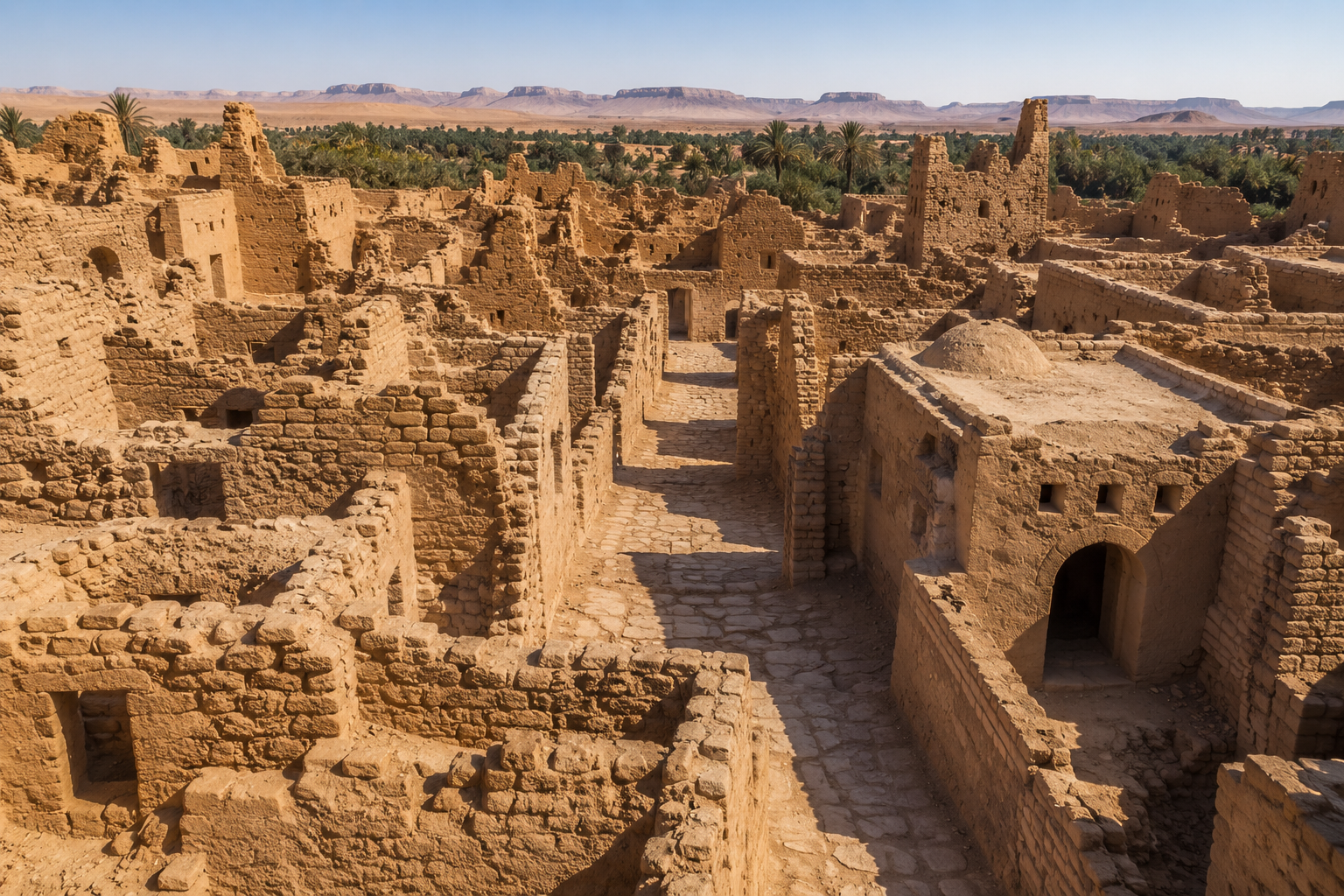
AI-generated reconstruction for educational purposes. This is an artistic visualization inspired by the Ain El-Sabil discovery, not a photograph or precise archaeological reconstruction of the site.
The Byzantine Basilica at the Heart of the Settlement
Religion was an important part of life at Ain El-Sabil.
Archaeologists uncovered a basilica church dating to approximately the middle of the fourth century CE. Its location overlooking one of the settlement’s principal streets suggests that it occupied a prominent position within the community.
The discovery is particularly interesting because researchers also identified evidence of earlier Christian activity.
One residence associated with a man named Tabibos dates to the early fourth century and has been interpreted as possibly having functioned as a house church before construction of the larger basilica.
Another important residence belonged to Tisous, identified in the archaeological reporting as a church deacon. His house dates to the second half of the fourth century.
These discoveries provide a glimpse of a community living during an important period in the history of Christianity in Egypt.
Instead of seeing religious change only through monumental churches in major cities, Ain El-Sabil allows archaeologists to investigate how Christian institutions developed within a comparatively remote oasis settlement.
What Do the 200 Written Pottery Fragments Reveal?
Among the most important finds from Ain El-Sabil are approximately 200 ostraca.
An ostracon is a fragment of pottery used as a writing surface. Broken pottery was readily available, making these pieces practical materials for short documents, notes, accounts and correspondence.
The Ain El-Sabil ostraca contain writing in both Greek and Coptic.
According to the archaeological announcement, the texts preserve information about commercial transactions, correspondence and other aspects of everyday life.
Their importance is difficult to overstate.
Architecture can tell archaeologists where people lived and how they organized space. Pottery and tools can reveal what people used. Coins can help establish chronology and economic connections.
Written records can sometimes bring researchers closer to individual actions and relationships.
Names, purchases, sales, messages and religious activities can transform an archaeological settlement into a community populated by identifiable people rather than anonymous ruins.
Researchers will need to continue studying and publishing these texts, but the collection has the potential to become one of the most valuable sources for understanding daily life at Ain El-Sabil.
Coins, Ovens and Everyday Life in the Desert
The spectacular architecture may attract attention, but many of the smaller finds are equally valuable to archaeologists.
Excavations produced domestic pottery, oil lamps, containers associated with oils and perfumes, stone grinding implements and equipment related to food preparation.
Bread ovens and kitchens provide direct evidence of daily routines.
Coins offer another important source of information.
Archaeologists recovered numerous well-preserved bronze coins displaying imperial portraits, Latin inscriptions and Christian symbols. Gold coins associated with the reign of Constantius II, who ruled from 337 to 361 CE, provide valuable chronological evidence for occupation during the fourth century.
Together, these objects reveal a community that was neither empty nor marginal.
Its inhabitants participated in an economy, prepared food, exchanged goods, communicated in writing and maintained religious institutions.
The discovery therefore provides something archaeology rarely offers so clearly: multiple categories of evidence from the same community that can be studied together.
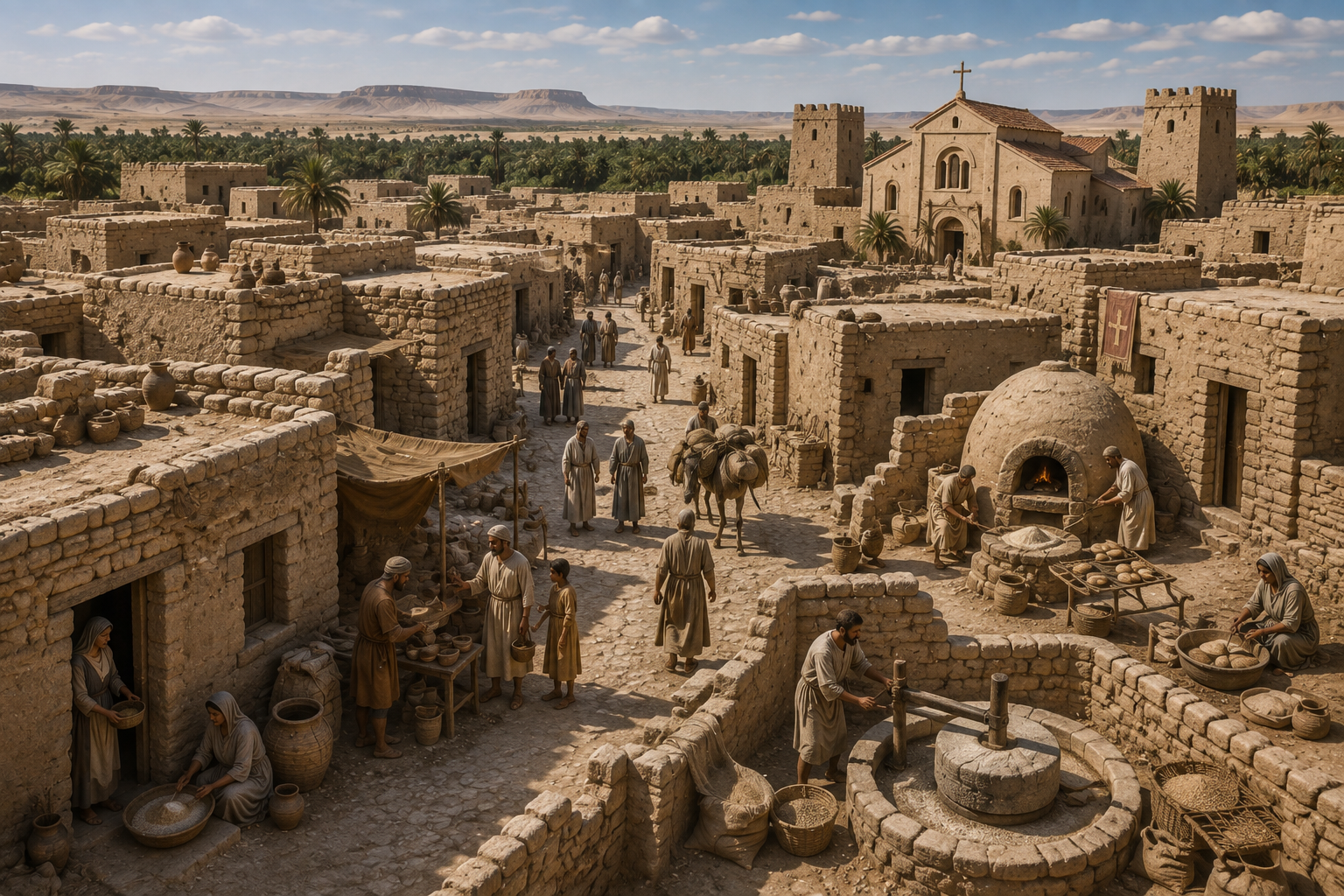
AI-generated illustration for educational purposes, inspired by daily life in Byzantine-era Dakhla Oasis. It does not represent the exact appearance of the Ain El-Sabil settlement.
Why Was a Community Built in the Western Desert?
At first glance, establishing a substantial settlement deep in Egypt’s Western Desert might appear surprising.
But an oasis changes everything.
Groundwater and cultivable land allowed communities to survive and practice agriculture far from the Nile. Dakhla Oasis supported settlements through many periods of Egyptian history and formed part of broader systems of movement, production and exchange.
The facilities discovered at Ain El-Sabil indicate the importance of food production and storage within the settlement.
Grinding installations, ovens and kitchens point toward an agricultural community capable of supporting a substantial population.
The written records and coins, meanwhile, demonstrate connections to larger administrative, economic and cultural systems.
Ain El-Sabil therefore reminds us that Byzantine Egypt was not limited to Alexandria, the Nile Delta or the great settlements along the river.
Complex communities also flourished hundreds of kilometers into the desert.
Why This Discovery Matters
The Dakhla Oasis Byzantine City is particularly important because archaeologists can study architecture, religion, written records and everyday objects within the same archaeological context.The importance of Ain El-Sabil does not come from a single spectacular treasure.
It comes from preservation and context.
Archaeologists have houses, streets, religious buildings, defensive structures, household equipment, coins and written documents from the same settlement.
That combination allows researchers to investigate several dimensions of life simultaneously.
The street layout provides evidence of urban organization.
Homes reveal domestic architecture.
The basilica and possible earlier house church provide evidence for Christian religious life.
Ostraca document communication and economic activity.
Coins contribute chronological and economic information.
Food-production facilities reveal how people sustained themselves.
Together, these discoveries may help researchers reconstruct the social and economic organization of a fourth-century oasis community with unusual detail.
Was This Really a “Lost City”?
News reports understandably describe discoveries like Ain El-Sabil as “lost cities.”
The phrase is dramatic, but it requires some explanation.
The archaeological site itself was not an unknown civilization suddenly discovered for the first time in 2026. Archaeological work at Ain El-Sabil had taken place before the latest announcement, and excavation of the area has developed over multiple seasons.
What archaeologists announced in 2026 was the uncovering and documentation of an exceptionally complete Byzantine residential settlement and a major body of associated evidence.
Calling it a “lost city” therefore works as a popular description of a settlement whose streets, buildings and everyday life had disappeared beneath centuries of abandonment.
Scientifically, however, “Byzantine-era residential settlement at Ain El-Sabil” is more precise.
That distinction is important.
The real archaeological story is already remarkable without exaggeration.
Quick Facts
- Site: Ain El-Sabil
- Location: Dakhla Oasis, New Valley Governorate, Egypt
- Region: Western Desert
- Main period: Fourth century CE
- Historical context: Byzantine-era Egypt
- Primary construction material: Mud brick
- Religious structure: Mid-fourth-century basilica church
- Defensive structures: Two watchtowers and a heavily fortified building
- Written finds: Around 200 ostraca
- Languages on ostraca: Greek and Coptic
- Other finds: Bronze and gold coins, pottery, oil lamps and grinding tools
- Domestic evidence: Houses, kitchens, bread ovens and grain-processing facilities
- Discovery announced: July 2026
- Excavating authority: Egyptian mission of the Supreme Council of Antiquities
Frequently Asked Questions
What was discovered in Dakhla Oasis in 2026?
Egyptian archaeologists announced the uncovering of a well-preserved Byzantine-era residential settlement at Ain El-Sabil. It contains organized streets, houses, defensive structures, a basilica, food-production facilities, coins and around 200 inscribed pottery fragments.
How old is the Dakhla Oasis Byzantine settlement?
Much of the newly announced settlement dates to the fourth century CE, making the principal remains approximately 1,600 years old.
Where is Ain El-Sabil?
Ain El-Sabil is an archaeological site in Dakhla Oasis in Egypt’s New Valley Governorate, deep within the Western Desert.
What are ostraca?
Ostraca are fragments of pottery that were reused as inexpensive writing surfaces. The examples found at Ain El-Sabil contain Greek and Coptic texts relating to transactions, correspondence and everyday activities.
Was a church discovered at the site?
Yes. Archaeologists uncovered a basilica dating to around the middle of the fourth century CE. Evidence from another residence suggests that a house may have served an earlier Christian religious function before the basilica was constructed.
Were gold coins found?
Yes. Archaeologists reported gold coins dating to the reign of Constantius II, alongside numerous bronze coins carrying imperial portraits, inscriptions and Christian imagery.
Is Dakhla Oasis part of ancient Egypt?
Dakhla has a long history extending across multiple periods of Egyptian civilization. The Ain El-Sabil discovery discussed here belongs primarily to the much later fourth-century CE context of Egypt under Roman and Byzantine rule.
Is the site really a lost city?
“Lost city” is a popular description rather than the most precise archaeological term. Researchers describe the discovery as a Byzantine-era residential settlement at Ain El-Sabil that has been progressively uncovered through archaeological excavation.
Conclusion
The discovery at Ain El-Sabil is remarkable precisely because it reveals more than monumental architecture.
Its streets show how people moved through their community. Its houses preserve traces of domestic life. Ovens and grinding installations reveal how food was prepared. Coins provide evidence of chronology and economic activity, while the basilica and other Christian remains illuminate the religious transformation of fourth-century Egypt.
Most extraordinary of all may be the hundreds of inscribed pottery fragments that preserve traces of communication, commerce and individual lives.
Together, these discoveries allow archaeologists to reconstruct a community that flourished deep within Egypt’s Western Desert around 1,600 years ago.
Ain El-Sabil was not simply a collection of buildings surrounded by sand. It was a living community of people who worked, worshipped, traded, wrote messages and built homes in one of Egypt’s great oases.
The Dakhla Oasis Byzantine City is therefore significant not because of a single spectacular artifact, but because so many aspects of community life have survived together.
And as excavation and study continue, its surviving streets and documents may still have much more to reveal.
Continue Exploring Ancient Mysteries
Göbekli Tepe: The 12,000-Year-Old Mystery
Hidden Ancient Cities Beneath Egypt’s Sands: Discoveries That Changed History
The Lost City of Atlantis: Myth, History, and the Search for a Lost Civilization
Sources
Ahram Online — Egypt uncovers a complete Fourth Century AD Byzantine residential area in Dakhla Oasis
Smithsonian Magazine — 1,600-Year-Old Byzantine Christian Town in Egypt
The Art Newspaper — Hundreds of ancient coins and inscribed pottery fragments discovered at Byzantine site in Egypt