
The Baghdad Battery: Was Ancient Electricity Real?
Introduction
Could people have discovered electricity nearly 2,000 years before Benjamin Franklin? Hidden beneath the ruins of ancient Iraq, archaeologists uncovered a small clay jar that sparked one of history’s greatest technological mysteries. Known today as the Baghdad Battery, this unusual artifact has fascinated scientists, historians, and conspiracy theorists for decades.
Discovered near Baghdad in the 1930s, the artifact consists of a clay jar containing a copper cylinder and an iron rod. Some researchers believe it may have functioned as a primitive battery capable of producing a small electrical current when filled with an acidic liquid such as vinegar or grape juice. Others argue that there is no convincing evidence it was ever used to generate electricity.
Whether it was an ancient battery, a storage vessel, or part of a forgotten manufacturing process, the Baghdad Battery continues to challenge our understanding of ancient technology. It raises fascinating questions about how advanced early civilizations may have been and whether some historical knowledge has been lost over time.
In this article, we’ll explore the discovery of the Baghdad Battery, examine the competing scientific theories, explain how it might have worked, and discover why it remains one of archaeology’s most intriguing unsolved mysteries.
What Is the Baghdad Battery?
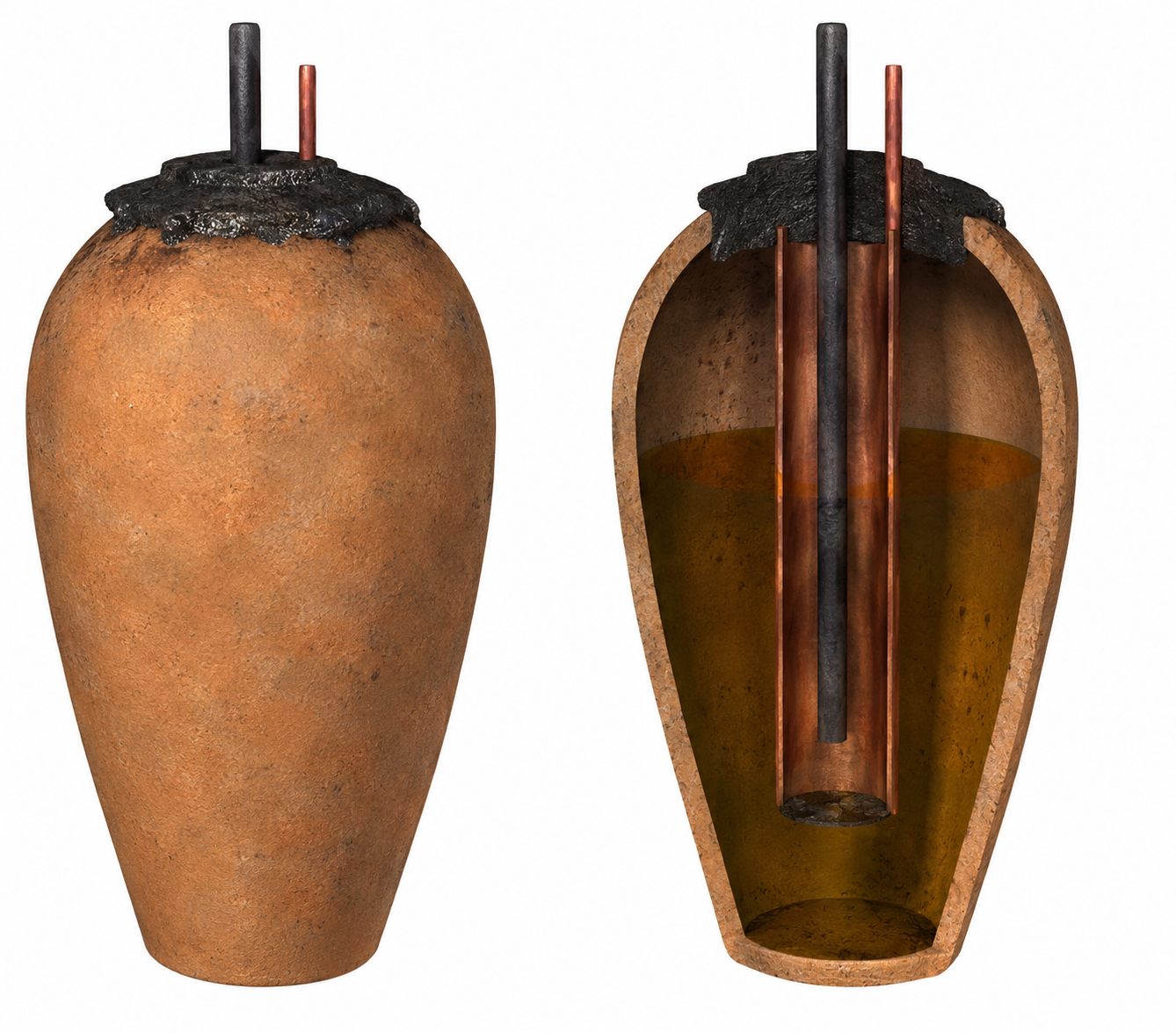
The Baghdad Battery is a small clay jar dating to the Parthian or early Sassanian period, approximately 2,000 years ago. Inside the jar, archaeologists found a rolled copper cylinder surrounding an iron rod. The top was sealed with bitumen, a natural form of asphalt commonly used in the ancient world.
Although the artifact resembles a simple storage container, its unusual construction has led some researchers to suggest that it could have produced a small electric current if filled with an acidic solution. Because of this possibility, the object became widely known as the “Baghdad Battery.”
Despite its popular name, no definitive evidence proves that the artifact was ever used to generate electricity. Many archaeologists believe it may have served an entirely different purpose, such as storing sacred scrolls, preserving documents, or assisting in metalworking techniques.
Today, the Baghdad Battery remains one of the most debated archaeological discoveries ever found in the Middle East.
Where Was the Baghdad Battery Discovered?
The artifacts commonly known as the Baghdad Batteries are associated with Khujut Rabu, an archaeological site near Baghdad, Iraq. They came to scholarly attention during the 1930s, when unusual ceramic vessels containing copper and iron components were examined by Wilhelm König, then associated with the Iraq Museum.
König proposed that the unusual combination of a clay vessel, copper cylinder, and iron rod might have been capable of producing a small electrical current. This interpretation eventually gave rise to the popular name “Baghdad Battery.”
Dating the objects precisely has proved difficult. They have often been associated with the Parthian period, although some researchers have suggested a later Sasanian date. This uncertainty is important because the archaeological context of the finds was not documented as thoroughly as archaeologists would expect from a modern excavation.
What made the discovery extraordinary was not simply the age of the objects, but their construction. If the components really were intended to generate electricity, they would represent an unexpectedly early application of electrochemical principles. However, that interpretation remains controversial, and alternative explanations for the vessels have also been proposed.
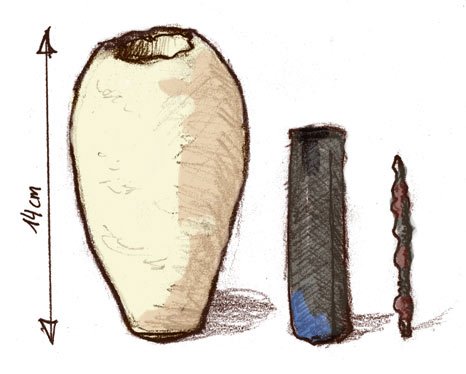
Illustration of the Baghdad Battery showing its clay vessel and internal components. Image by Ironie via Wikimedia Commons, licensed under CC BY-SA 2.5.
How Could the Baghdad Battery Have Worked?
The idea that the Baghdad Battery could have produced electricity comes from the unusual combination of materials found inside the clay vessel. The copper cylinder and iron rod are made from two different metals — a basic requirement for creating a simple electrochemical cell.
If the jar contained an acidic liquid, such as vinegar or fermented grape juice, chemical reactions between the liquid and the two metals could theoretically have produced a small electrical voltage. Modern reconstructions using similar materials have demonstrated that such an arrangement can generate electricity, although only in small amounts.
This does not prove that ancient people actually used the artifact as a battery. No wires or clear electrical equipment were discovered with the vessels, and researchers continue to debate their original purpose.
One popular suggestion is that electricity might have been used for electroplating — depositing a thin layer of metal onto another object. However, convincing archaeological evidence connecting the Baghdad Battery directly to electroplating has not been found.
For this reason, the electrical interpretation remains an intriguing hypothesis rather than an established archaeological fact.
Did Ancient Civilizations Really Use Electricity?
The possibility that ancient people understood electricity is the most fascinating — and controversial — part of the Baghdad Battery story. If the vessels were genuinely used as electrical cells, they would represent an extraordinary technological achievement for their time.
However, producing a small electrical voltage is very different from having a practical electrical technology. Archaeologists have found no ancient wires, electrical circuits, lamps, motors, or other equipment that would demonstrate widespread electrical use in Parthian or Sasanian society.
Some theories suggest that devices like the Baghdad Battery might have been used for electroplating, allowing craftsmen to coat objects with a thin layer of precious metal. Ancient metalworkers certainly possessed sophisticated techniques, but there is currently no conclusive archaeological evidence showing that electrical current was involved in those processes.
Another possibility is that the vessels had nothing to do with electricity at all. Similar containers have been interpreted as objects used for storing documents, ritual materials, or other substances. Without clearer archaeological context, determining their original purpose remains difficult.
The most reasonable conclusion is therefore not that ancient civilizations definitely possessed electrical technology, but that the unusual construction of these artifacts leaves a fascinating question that has never been conclusively resolved.
Why Do Many Scientists Disagree?
Despite its famous nickname, the Baghdad Battery has never been conclusively proven to be a battery. The electrical interpretation is based largely on the fact that its copper and iron components could theoretically produce a small voltage when combined with an acidic liquid.
One of the strongest objections is the lack of supporting archaeological evidence. No wires, conductors, electrical devices, or written instructions explaining the use of electricity have been discovered alongside the artifacts. If the vessels were part of a practical electrical system, researchers would expect to find at least some evidence of the equipment connected to them.
The electroplating theory is also disputed. Although experiments with modern replicas have shown that a similar arrangement can generate a small electrical current, demonstrating that something can work as a battery does not prove that this was its original purpose.
Alternative explanations suggest that the vessels may have been used to store scrolls, ritual objects, or other materials. Unfortunately, uncertainties surrounding their original archaeological context make it difficult to determine which explanation is correct.
For now, the Baghdad Battery remains a fascinating example of how a single archaeological object can inspire radically different interpretations. Its mystery lies not in proof of ancient electricity, but in the fact that we still cannot say with certainty what its creators intended it to do.
Quick Facts
Estimated age: Around 2,000 years
Associated period: Parthian or Sasanian period
Location: Khujut Rabu, near Baghdad, Iraq
Materials: Clay, copper, iron, and bitumen
Modern name: Baghdad Battery
Proposed function: Possible electrochemical cell
Possible electrolyte: An acidic liquid such as vinegar or fermented juice
Electrical use proven?: No — the battery interpretation remains disputed
Frequently Asked Questions
What is the Baghdad Battery?
The Baghdad Battery is the popular name given to a group of ancient clay vessels containing copper and iron components associated with Khujut Rabu near Baghdad, Iraq. Their unusual construction led to the theory that they may have functioned as primitive electrochemical cells, although this interpretation remains disputed.
How old is the Baghdad Battery?
The artifacts are generally associated with the Parthian or Sasanian periods and are roughly 2,000 years old. Their precise date remains uncertain because of limitations surrounding their original archaeological context.
Could the Baghdad Battery really produce electricity?
A reconstruction using a copper cylinder, an iron rod, and a suitable acidic electrolyte can produce a small electrical voltage. However, showing that such an arrangement can generate electricity does not prove that the ancient artifact was originally designed for that purpose.
What was the Baghdad Battery used for?
Its original purpose is unknown. Proposed explanations include use as an electrochemical device, possibly for electroplating, as well as non-electrical functions involving the storage of materials or ritual objects. None of these explanations has been conclusively proven.
Did ancient Iraqis know about electricity?
There is currently no conclusive archaeological evidence showing that people in ancient Iraq possessed or routinely used electrical technology. The Baghdad Battery hypothesis remains an intriguing possibility rather than proof of an ancient electrical system.
Where is the Baghdad Battery today?
The original artifacts became associated with the Iraq Museum in Baghdad. Their later status has been difficult to establish publicly following the disruption and looting of the museum during the 2003 invasion of Iraq.
Conclusion
The Baghdad Battery remains one of archaeology’s most intriguing technological mysteries. Its combination of a clay vessel, copper cylinder, and iron rod demonstrates that an arrangement resembling a simple electrochemical cell existed nearly 2,000 years ago.
Experiments with modern reconstructions show that similar components can produce a small electrical voltage when combined with a suitable electrolyte. Yet this alone does not prove that the original artifacts were designed to generate electricity. The absence of wires, electrical devices, and clear written evidence leaves the battery theory open to debate.
Perhaps the real fascination of the Baghdad Battery lies in this uncertainty. It reminds us that archaeological objects do not always reveal their purpose easily, and that our understanding of ancient technology can change as new evidence emerges.
Whether it was an early electrical device or something entirely different, the Baghdad Battery remains an extraordinary artifact—and a compelling reminder of how much about the ancient world we still do not fully understand.
Continue Exploring Ancient Mysteries
- The Antikythera Mechanism: The Ancient Computer That Shouldn’t Exist
- Hidden Ancient Cities Beneath Egypt’s Sands: Discoveries That Changed History
- The Terracotta Army: The Incredible Secret Buried with China’s First Emperor
Sources
Smith College – Museum of Ancient Inventions: Baghdad Battery
Smithsonian Museum Conservation Institute – Electricity Generation or Magic?