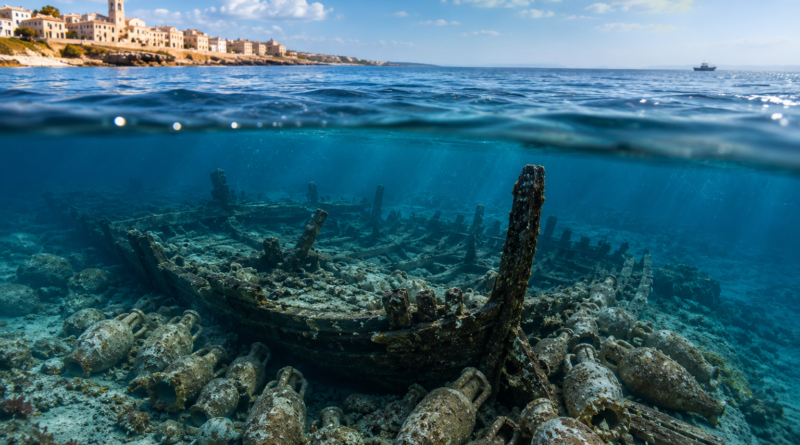
2,100-Year-Old Roman Shipwreck Found Off Sicily With 500 Ancient Amphorae
Introduction
A remarkable Roman Shipwreck Sicily discovery has revealed hundreds of ancient amphorae resting on the Mediterranean seabed more than 2,000 years after the vessel sank.
The wreck was identified approximately three miles off the coast of Mazara del Vallo in western Sicily, at a depth of about 46 meters. Archaeologists estimate that the vessel measures roughly 21 meters long and six meters wide, making it a substantial ancient merchant ship.
But its cargo is what makes the discovery particularly extraordinary.
Around 500 amphorae remain associated with the wreck, many remarkably well preserved. Most have been identified as Dressel 1A amphorae, a type widely used during the second and first centuries BCE and strongly associated with the transportation of wine.
The wreck therefore represents far more than an ancient maritime accident. It is a snapshot of Mediterranean commerce preserved beneath the sea.
Where was the ship traveling? What exactly did its amphorae contain? Where was its cargo produced? And could part of the vessel’s wooden hull still survive beneath the layers of pottery?
Researchers are only beginning to investigate those questions.
Where Was the Roman Shipwreck Found?
The wreck lies approximately three miles off Mazara del Vallo, a coastal city in southwestern Sicily overlooking the Mediterranean.
It rests about 46 meters beneath the surface.
At that depth, archaeological investigation requires trained divers, underwater imaging equipment and careful planning. The location also helps explain why such a substantial concentration of archaeological material could remain undisturbed for centuries.
Sicily occupied a crucial position in the ancient Mediterranean.
Ships traveling between the Italian Peninsula, North Africa, the western Mediterranean and other ports frequently passed through waters surrounding the island. After Rome gained control of Sicily during the third century BCE, the island became increasingly integrated into Roman political and commercial networks.
The Roman Shipwreck Sicily discovery therefore lies in waters that once formed part of one of antiquity’s most important maritime crossroads.
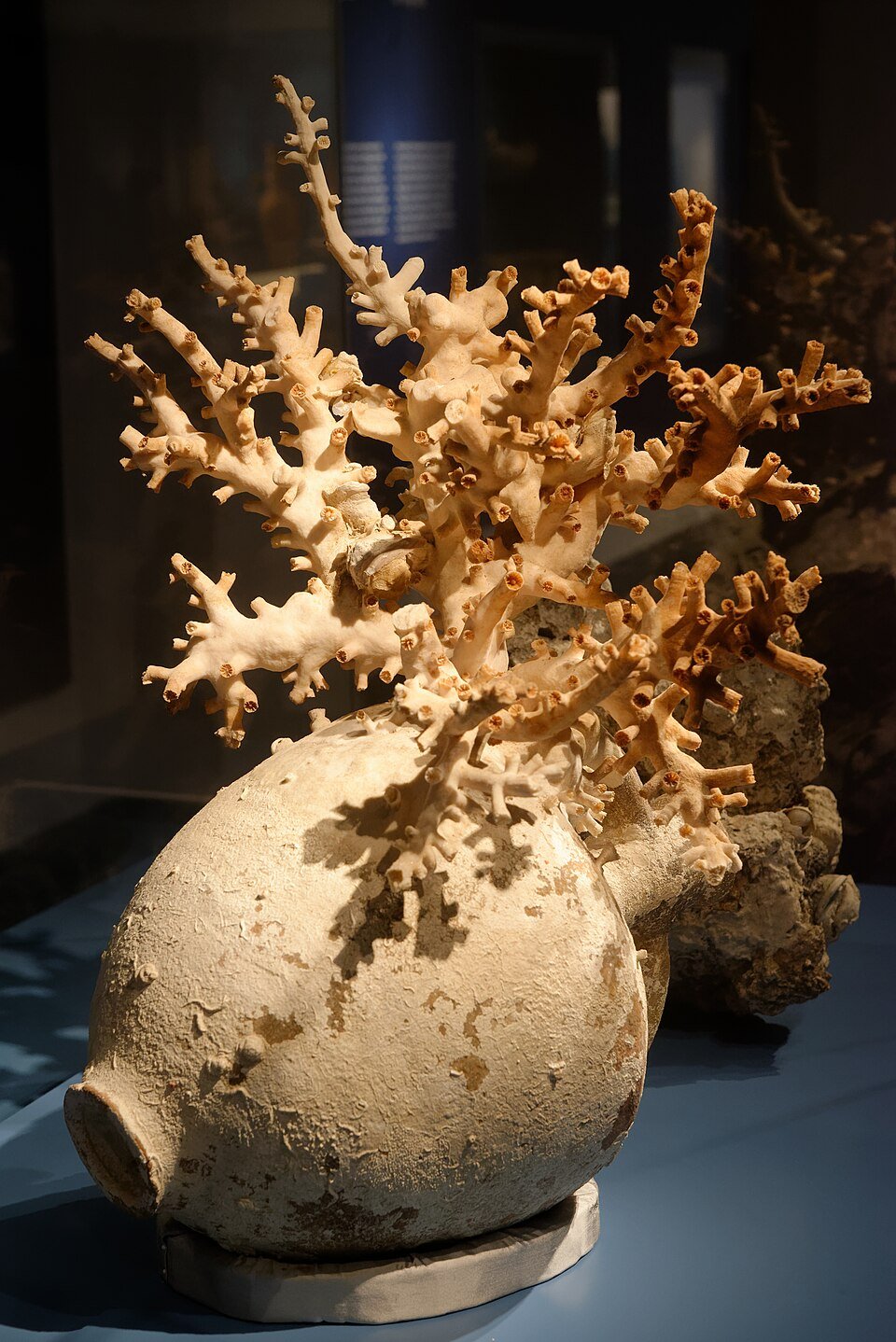
Roman amphora from the Levanzo I shipwreck in Sicily. Used for historical context; this artifact is not from the newly discovered Mazara del Vallo wreck. Source: Wikimedia Commons.
How Was the Shipwreck Discovered?
The wreck came to official attention after information from people familiar with the local waters led investigators to examine the seabed.
Divers Giacomo De Mola and Igor Bisulli were among those associated with identifying the extraordinary concentration of archaeological material.
What initially appeared underwater as an unusual feature on the seabed proved to be something far more significant: hundreds of ancient amphorae concentrated around the remains of a large vessel.
Italian authorities subsequently investigated the site with specialist divers and underwater recording equipment.
The scale of the find quickly became apparent.
Instead of a handful of isolated ceramic fragments, investigators were looking at the cargo of an ancient merchant vessel that had remained on the Mediterranean seabed for roughly two millennia.
Italy’s culture minister described the discovery as one of the most important underwater archaeological finds of recent years.
What Are the 500 Ancient Amphorae?
Amphorae were among the most important containers of the ancient Mediterranean world.
Typically made from ceramic, they had two handles, narrow necks and pointed or rounded bases depending on their type. They could be transported aboard ships in large numbers and were used for commodities including wine, olive oil, fish products and other goods.
Approximately 500 amphorae have been reported at the newly identified wreck.
Most appear to belong to the Dressel 1A type.
Dressel 1 amphorae are particularly associated with Roman wine commerce during the late Republican period, and Dressel 1A vessels were widely produced and circulated during the second and first centuries BCE.
That makes wine a strong possibility for the ship’s principal cargo.
However, there is an important distinction.
The archaeological type of an amphora can tell researchers a great deal about its date, production and typical use, but it does not automatically prove what remained inside every vessel when this particular ship sank.
Scientific examination of residues, sediments and the ceramics themselves may eventually provide more definitive evidence.
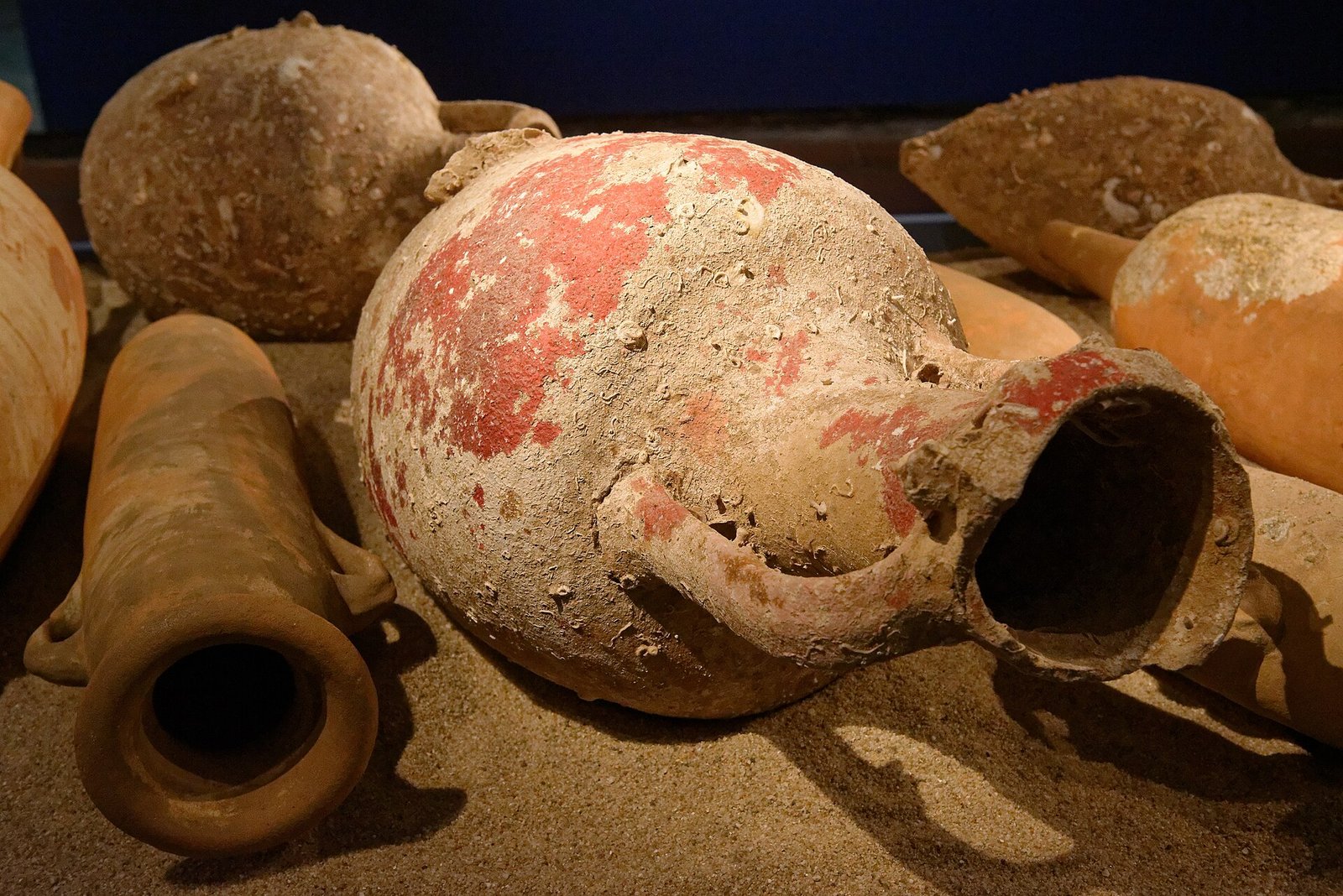
Roman amphorae from the Levanzo I shipwreck in Sicily. Photo by Marie-Lan Nguyen via Wikimedia Commons, CC BY 4.0. These artifacts are shown for historical context and are not from the newly discovered Mazara del Vallo wreck.
How Old Is the Roman Shipwreck?
The preliminary archaeological dating places the wreck approximately in the second to first centuries BCE.
That makes it roughly 2,100 years old.
This period belongs to the Roman Republic rather than the later Roman Empire that many people picture when they hear the word “Roman.”
It was an era of enormous political and economic expansion.
Roman power had spread across much of the Mediterranean, and maritime trade moved enormous quantities of agricultural products and manufactured goods between ports.
Wine was particularly important.
Italian wine traveled widely, and amphorae have become one of the most useful archaeological tools for tracing ancient production and trade.
If the dating of the Mazara del Vallo wreck is confirmed, its cargo could provide an unusually concentrated body of evidence from this transformative period of Mediterranean history.
What Else Was Found on the Seabed?
The hundreds of amphorae are the most visually striking part of the discovery, but they are not the only archaeological material reported at the site.
Investigators have also identified lead elements associated with the vessel, including two lead anchor stocks.
Such objects can provide valuable information about ancient maritime technology.
Even more intriguing is what may remain hidden beneath the visible cargo.
Wood normally deteriorates quickly in many environments, but underwater conditions can sometimes preserve parts of ancient ship structures when they become buried beneath sediment or protected from organisms that destroy exposed timber.
Researchers therefore hope further investigation may reveal whether portions of the ship’s wooden hull survive beneath the amphorae and seabed deposits.
If substantial timbers are preserved, the wreck could potentially provide evidence not only about trade but also about Roman ship construction.
Where Was the Ship Going?
This is one of the biggest unanswered questions.
Finding a shipwreck tells archaeologists where a voyage ended—not necessarily where it began or where the crew intended to go.
The amphorae may eventually provide clues.
Ceramic specialists can examine clay composition, manufacturing techniques, shapes, stamps and other characteristics to determine where containers were produced. Residue analysis can sometimes identify what they carried.
Researchers can then compare those findings with known production centers and ancient trade networks.
The location near western Sicily is particularly interesting because vessels passing through the region could have been traveling between Italy, Sicily, North Africa and destinations farther west or east.
At present, however, the ship’s precise origin and intended destination remain under investigation.
Any claim that researchers already know its exact route would go beyond the available evidence.
Why Did the Ship Sink?
We do not yet know.
Ancient ships faced numerous hazards.
Storms could overwhelm vessels, navigational errors could drive them toward dangerous waters, structural problems could cause catastrophic failures, and heavily loaded merchant ships were vulnerable when weather conditions changed rapidly.
But those are general possibilities, not explanations for this specific wreck.
No confirmed cause of sinking has yet been established.
Archaeologists will need to study the orientation of the wreck, surviving structural elements, distribution of cargo and surrounding seabed before they can determine whether evidence survives for the vessel’s final moments.
This uncertainty is one of the reasons the site is so valuable.
The seabed may preserve information about the disaster that written history never recorded.
What Can the Wreck Tell Us About Roman Trade?
A merchant ship carrying hundreds of standardized transport containers represents an entire economic system frozen at the moment of disaster.
Before an amphora reached the ship, someone had to manufacture it.
The commodity inside had to be produced, processed and packed.
Merchants or administrators organized its movement to a port. Dockworkers loaded the cargo. Sailors then attempted to transport it across the Mediterranean to buyers elsewhere.
Multiply that process by hundreds of amphorae and the scale of ancient commerce becomes much easier to appreciate.
The Roman Shipwreck Sicily site could therefore help researchers investigate trade routes, commodity production, cargo organization and maritime transportation during the late Republican period.
The wreck may also help researchers compare archaeological evidence from the seabed with amphorae found at production sites and settlements around the Mediterranean.
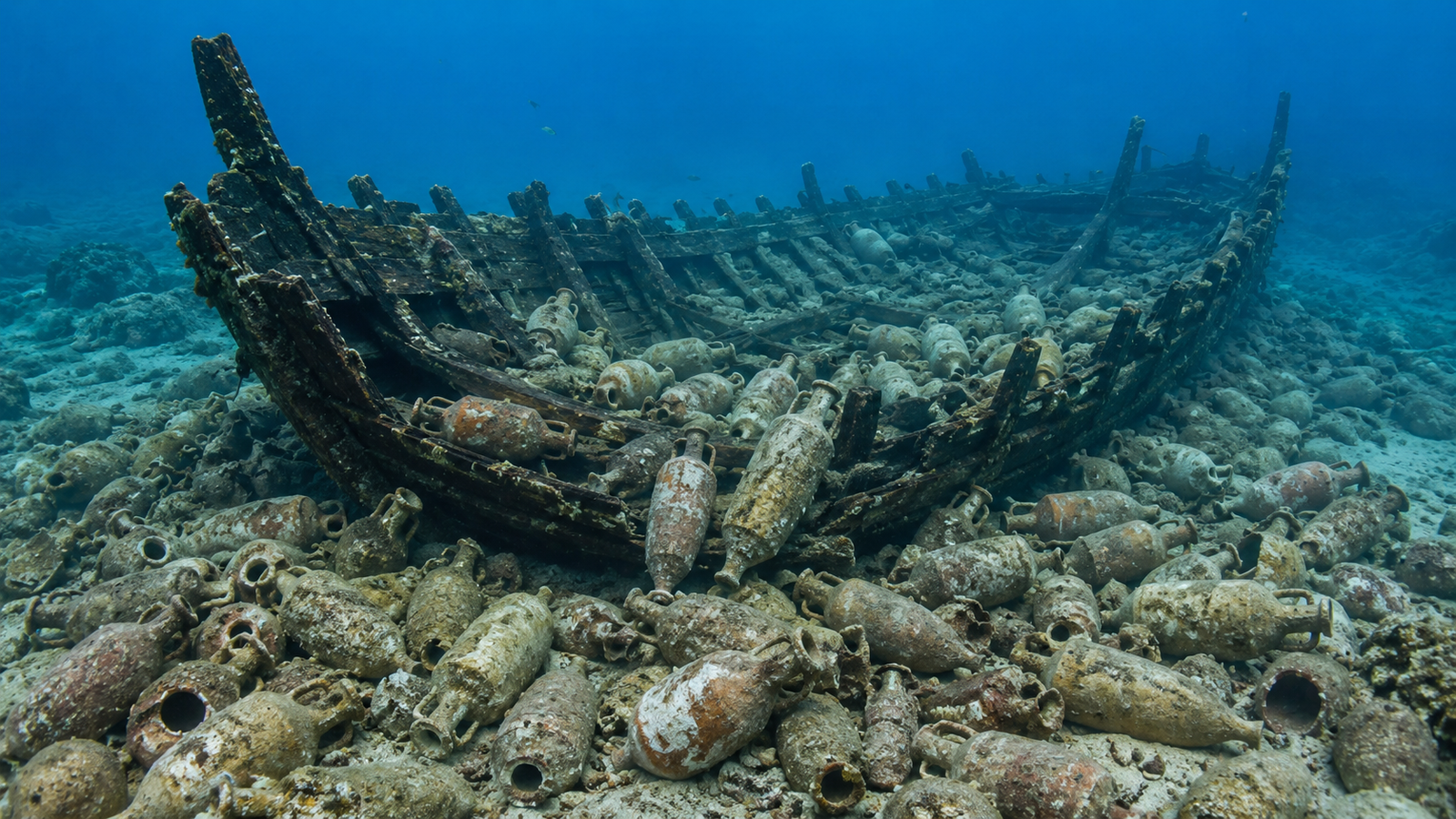
AI-generated educational reconstruction inspired by the Roman shipwreck discovered off Sicily. The scene is an artistic visualization and does not depict the exact Mazara del Vallo wreck.
Why Sicily Was Crucial to Mediterranean Trade
Geography made Sicily extraordinarily important.
The island sits near the center of the Mediterranean, between the Italian Peninsula and North Africa and between the eastern and western parts of the sea.
This position made Sicily strategically important for warfare, migration and commerce.
Rome’s struggle with Carthage during the Punic Wars demonstrated the island’s military importance. After Sicily became Rome’s first province, its agricultural resources and ports became increasingly integrated into Roman economic networks.
But Sicily was not simply a destination.
Its surrounding waters formed maritime corridors through which vessels moved between many different regions.
The newly discovered wreck near Mazara del Vallo is therefore part of a much larger archaeological story hidden beneath the Mediterranean.
An Underwater Archaeological Time Capsule
Shipwrecks are unusual archaeological sites because they can preserve a single historical event with extraordinary clarity.
A settlement may be occupied for centuries. Buildings are rebuilt, objects are moved, rubbish is discarded and later inhabitants alter earlier layers.
A shipwreck can be different.
When a vessel sinks rapidly, cargo, equipment and parts of the ship may reach the seabed together.
That creates what archaeologists sometimes describe conceptually as a closed archaeological context—a collection of objects associated with a particular voyage and moment in time.
The Mazara del Vallo wreck potentially preserves hundreds of objects that traveled together.
Studying their arrangement could help archaeologists understand how the vessel was loaded and perhaps what happened as it sank.
What Happens to the Shipwreck Now?
Finding an ancient shipwreck is only the beginning.
The next stage involves documentation, scientific analysis, protection and conservation planning.
Sicily’s Superintendency of the Sea is expected to conduct detailed research aimed at refining the wreck’s chronology and determining more about the origin and destination of its cargo.
Researchers may use underwater photogrammetry to construct detailed three-dimensional models without disturbing the site.
Selected artifacts could potentially be recovered for specialist analysis, but removing archaeological material from the sea creates conservation challenges. Objects that have remained underwater for centuries can deteriorate if they are brought to the surface without appropriate treatment.
For that reason, modern underwater archaeology often emphasizes careful documentation and preservation rather than simply recovering everything from the seabed.
What We Still Don’t Know
Despite the spectacular images and headlines surrounding the discovery, several fundamental questions remain unanswered.
Researchers still need to establish the wreck’s precise date.
The exact production origins of the amphorae require further study.
The contents of the individual vessels have not yet been definitively established.
The ship’s port of departure and intended destination remain unknown.
The reason it sank is also uncertain.
And archaeologists still need to determine how much of the original wooden vessel survives beneath the visible cargo.
These unanswered questions do not diminish the discovery.
They are precisely what makes archaeological investigation worthwhile.
Quick Facts
- Location: Off Mazara del Vallo, Sicily, Italy
- Distance from shore: Approximately 3 miles
- Depth: About 46 meters
- Estimated vessel size: Approximately 21 meters long and 6 meters wide
- Estimated age: Around 2,100 years
- Preliminary date: Second–first centuries BCE
- Historical period: Roman Republic
- Cargo: Approximately 500 amphorae
- Main amphora type: Dressel 1A
- Likely commodity associated with this type: Wine
- Other reported finds: Two lead anchor stocks and other lead elements
- Exact cargo contents: Not yet confirmed
- Ship’s origin: Under investigation
- Destination: Under investigation
- Cause of sinking: Unknown
- Further research: Planned by Sicily’s underwater archaeological authorities
Frequently Asked Questions
Where was the Roman shipwreck discovered?
The wreck was discovered approximately three miles off Mazara del Vallo on the southwestern coast of Sicily, Italy, at a depth of about 46 meters.
How old is the Sicily shipwreck?
Preliminary dating places the wreck in the second to first centuries BCE, making it approximately 2,100 years old.
How many amphorae were found?
Around 500 amphorae have been reported at the wreck site.
What did the amphorae contain?
Most of the amphorae appear to be Dressel 1A vessels, a type strongly associated with transporting wine. However, researchers have not yet definitively established the contents of every amphora from this wreck.
Was the ship from the Roman Empire?
Not in the usual chronological sense. The preliminary second-to-first-century BCE dating places the vessel in the period of the Roman Republic, before Augustus established the imperial system.
Why are amphorae important to archaeologists?
Their shapes, manufacturing materials, stamps and contents can help researchers determine dates, production regions, trade connections and the commodities transported across the ancient Mediterranean.
Is the wooden ship still preserved?
Researchers have not yet established how much of the hull survives. Parts of the vessel may potentially remain protected beneath the cargo and seabed sediments, making further archaeological investigation particularly important.
Do archaeologists know why the ship sank?
No. The cause of the sinking remains unknown.
Conclusion
More than two millennia after a Roman merchant vessel disappeared beneath the Mediterranean, hundreds of its transport jars still rest together on the seabed off Sicily.
The discovery near Mazara del Vallo offers archaeologists much more than an impressive collection of ancient pottery.
It potentially preserves evidence about how merchants organized cargo, how goods moved across the Mediterranean, what routes sailors followed and how ships were constructed during a crucial period of Roman expansion.
Yet many of the most fascinating questions remain open.
We still do not know exactly where the ship began its final voyage, where it was heading, what caused it to sink or precisely what survived inside its amphorae.
Future investigation may answer some of those questions.
For now, the Roman Shipwreck Sicily discovery remains an extraordinary underwater time capsule—a merchant voyage from more than 2,000 years ago, interrupted and preserved beneath the Mediterranean Sea.
Continue Exploring Ancient Mysteries
Antikythera Mechanism
Sources
- The Guardian — Roman shipwreck with 500 amphorae found off coast of Sicily
- Soprintendenza del Mare