Nebra Sky Disc: Meaning, Age and Discovery
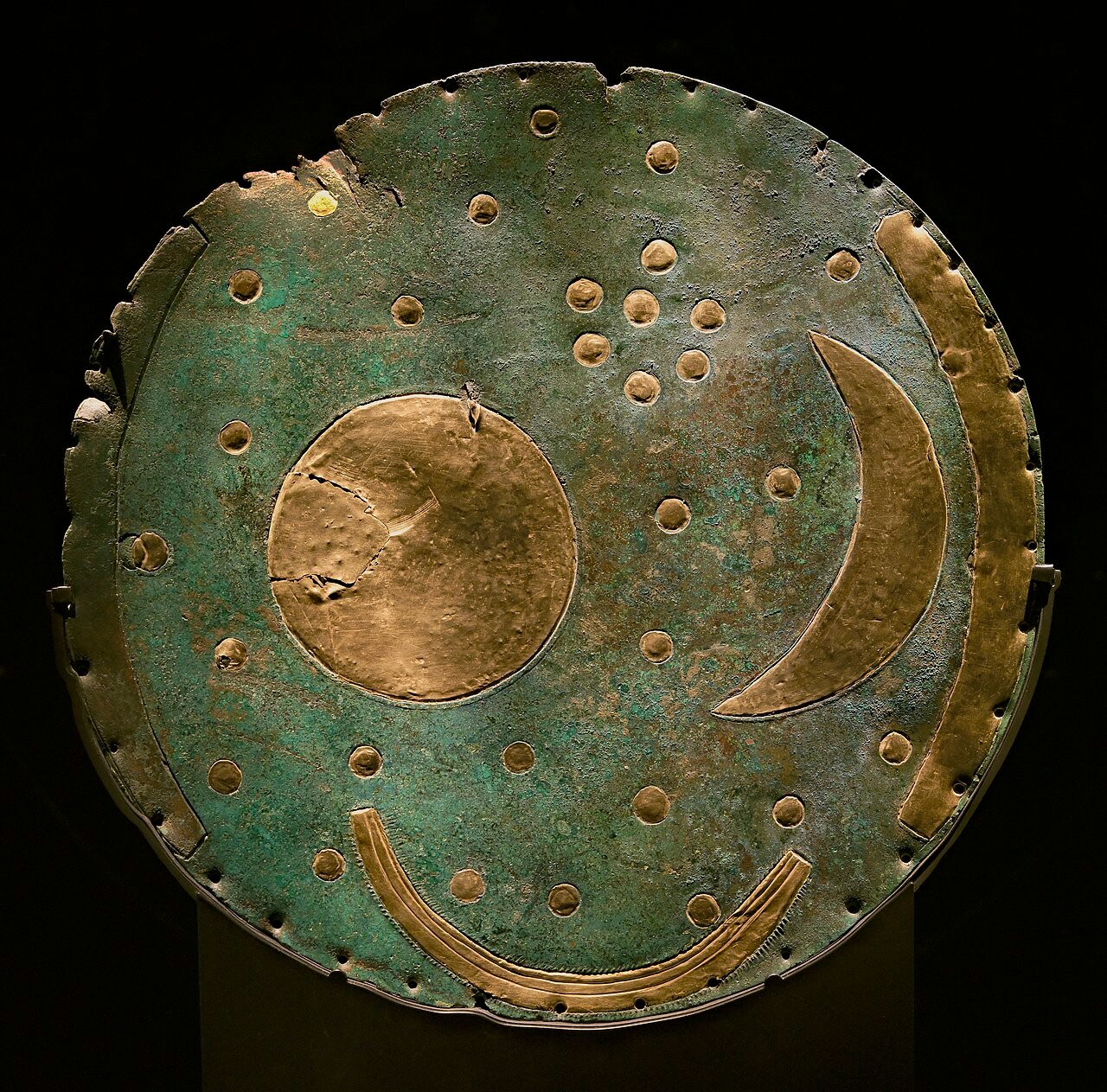
The Nebra Sky Disc is one of Europe’s most extraordinary Bronze Age artifacts. A bronze disc decorated with gold symbols, it brings together imagery that appears to represent heavenly bodies and horizons. Its significance lies not in proving that ancient people had modern astronomy, but in showing how sky observation and belief could intersect thousands of years ago.
What Is the Nebra Sky Disc?
The object is a bronze disc with gold applications usually interpreted as the sun or full moon, a crescent moon, and stars. Additional curved bands were applied during different stages of the disc’s history. Scholars have proposed that these relate to the horizon and a boat-like solar symbol.
The State Museum of Prehistory in Halle, Germany, describes it as an exceptionally early concrete depiction of astronomical phenomena and dates its cultural significance to roughly 3,600 years ago.
How Was It Discovered?
Unlike a carefully excavated object whose position can be recorded immediately, the Nebra Sky Disc has a troubled modern history. Metal detectorists illegally recovered it near the Mittelberg hill in 1999, along with other Bronze Age objects, according to the State Museum of Prehistory.
The find then passed through illicit hands before police recovered it in Basel in February 2002. This history matters because removing an artifact without scientific excavation damages its archaeological context. Researchers had to reconstruct the circumstances of discovery from later investigation.
What Do the Gold Symbols Mean?
The stars and crescent
Many observers identify a group of clustered dots with the Pleiades, a star cluster visible to the naked eye. That identification has influenced interpretations connecting the disc with seasonal observations. Such readings are plausible scholarly interpretations, not captions left by its makers.
The horizon arcs
Two long curved bands were added along the edges in a later phase; one is now missing. They have often been interpreted in relation to the changing positions of sunrise and sunset along the horizon during the year.
The boat-like shape
A further gold element resembles a curved vessel. The museum connects it with the idea of a celestial boat, a symbol through which the daily and nightly journeys of the sun could be understood in mythic terms.
Was It a Scientific Instrument?
It is tempting to label the disc an ancient astronomical calculator. Yet that description can suggest a mechanical precision that the surviving object does not prove. The more careful view is that the disc may embody observations of sky cycles together with religious or cosmological meanings.
The order in which its elements were added also matters. The object appears to have changed over time, which means there may not have been a single permanent message. Different generations could have reinterpreted or modified it.
Why Its Archaeological Context Matters
The disc’s illicit recovery prompted debates over its date and original setting. Those disagreements are part of genuine archaeological scholarship, not evidence that the object is inherently a hoax. Evaluating the object requires combining scientific examination, associated finds, regional archaeology, and the history of its recovery.
Its display in Halle gives visitors a chance to see why context, provenance, and interpretation are inseparable when working with ancient artifacts.
What Makes the Nebra Sky Disc Important?
Whether its images were used to teach seasonal knowledge, express cosmological beliefs, or reinforce social authority, the disc shows that Bronze Age communities could represent celestial patterns in a deliberate visual language.
It is most fascinating when viewed as an object at the boundary of observation, craftsmanship, and mythology—not as a magical device whose secrets have all been solved.
Frequently Asked Questions
How old is the Nebra Sky Disc?
It is generally associated with the European Bronze Age and commonly described as roughly 3,600 years old.
Where is it displayed?
The original is held by the State Museum of Prehistory in Halle, Germany.
Does it show the Pleiades?
A cluster of gold dots is widely interpreted that way, although the makers left no written explanation confirming the identification.
Continue Exploring
Compare this artifact with the more mechanically complex Antikythera Mechanism, another object that reveals ancient interest in the sky.