Lycurgus Cup: Why Does This Roman Glass Change Color?
Why the Lycurgus Cup Still Surprises Visitors
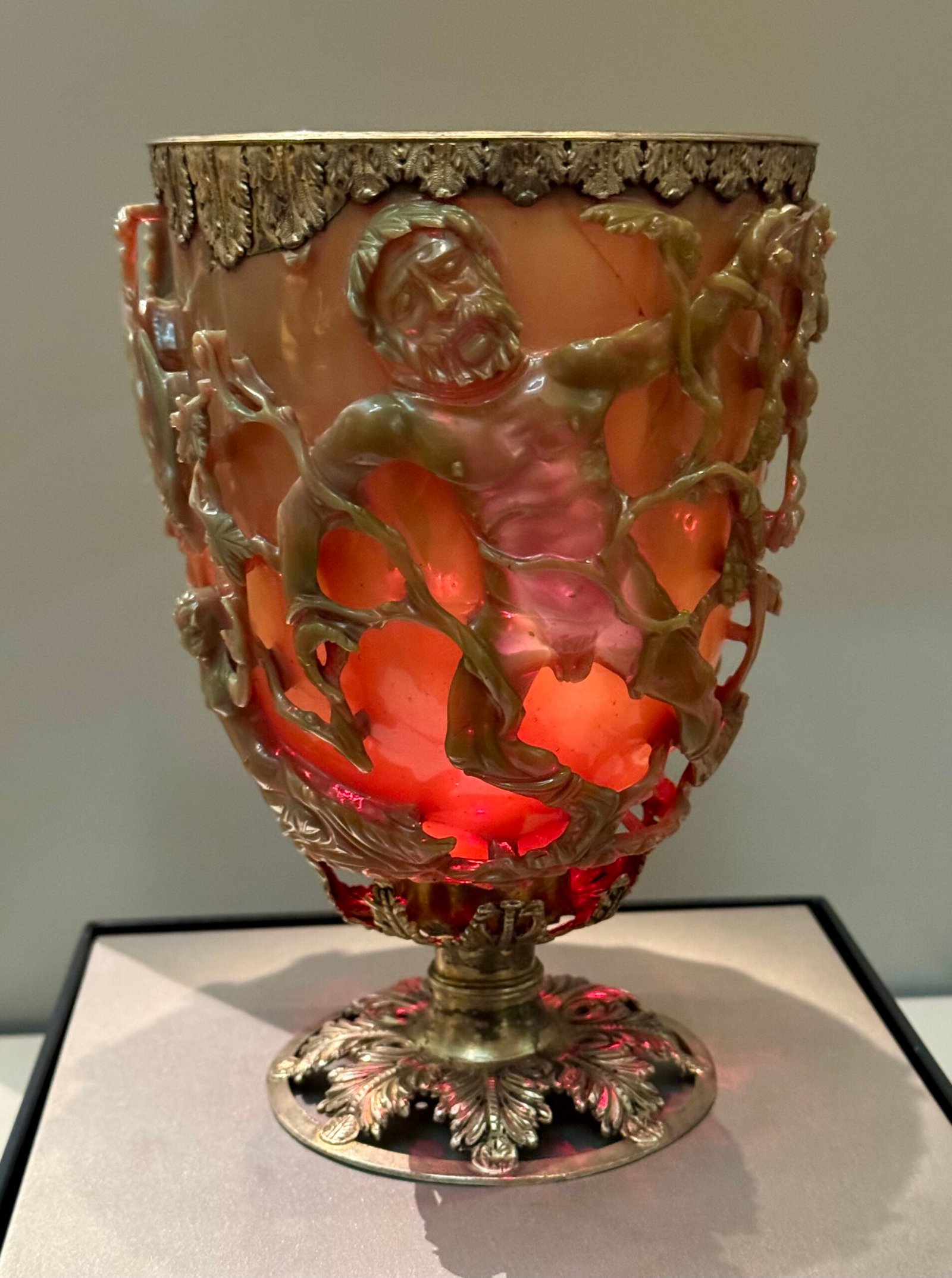
The Lycurgus Cup looks like a work of ancient magic. In reflected light, its glass can appear green; with light passing through it, the same vessel glows red. The effect has made this fourth-century Roman drinking cup a celebrated example of ancient craftsmanship.
The change has a physical explanation, not a supernatural one. Tiny amounts of gold and silver dispersed in the glass affect the way light is transmitted and scattered. Yet explaining the phenomenon is not the same as knowing exactly how Roman craftspeople controlled every stage of its manufacture.
What Is the Lycurgus Cup?
The British Museum identifies the cup as a late Roman glass drinking vessel dating to the fourth century CE. It is a rare cage cup: its figures were fashioned in relief by removing glass around them, leaving a complex design that appears to wrap around the vessel.
The object also has silver-gilt fittings. Its intricate surface, unusual glass and elaborate decoration suggest that it was an exceptional luxury possession rather than a practical everyday cup.
How Can One Cup Be Both Green and Red?
The phenomenon is commonly called dichroism. The cup looks different depending on how it is illuminated and viewed. Under reflected light it appears green; when light shines through the vessel it takes on a striking translucent red color.
The British Museum attributes the effect to very small quantities of gold and silver in the glass. At extremely small scales, metal particles interact with light in ways that bulk pieces of the same metals do not.
This is sometimes described as ancient nanotechnology. That phrase can be useful for explaining the material’s properties, but it does not prove that Roman artisans understood modern particle physics or could specify nanoparticle dimensions as scientists do today.
What Story Is Carved on the Cup?
The decoration draws on the Greek myth of Lycurgus, king of Thrace, and his conflict with Dionysus, the god associated with wine. In the scene, Lycurgus is caught in a vine after turning against Dionysus and his followers.
The choice of subject makes sense on a drinking vessel, although the exact social setting in which the cup was displayed or used is not securely known. Images inspired by mythology communicated status and learning as well as serving a decorative purpose.
Was the Color Change Accidental?
The surviving cup is evidence of extraordinarily skillful glassmaking, but it cannot by itself answer whether artisans fully anticipated its optical behavior or arrived at the recipe through experimentation.
Ancient workshops accumulated technical knowledge over generations. The demanding processes of creating colored glass, working metal fittings and carving delicate relief decoration required specialized skills, even without a modern scientific vocabulary.
What Makes It Different From Ordinary Roman Glass?
Much Roman glass survives as fragments of bottles, cups, windows and containers. The Lycurgus Cup is exceptional because its dichroic material is combined with elaborate relief carving and luxurious metalwork.
Its fascination lies in this combination. The glass demonstrates a surprising optical response, while the carved scene preserves a conversation between Roman art, Greek mythology and the culture of elite dining.
Questions Readers Often Ask
Is the Lycurgus Cup genuine? Yes. It is a documented late Roman object in the British Museum’s collection.
Is it the oldest color-changing glass? It is among the best-known ancient examples, but broad ‘first ever’ claims require stronger comparative evidence.
Where is it kept? The cup belongs to the British Museum in London; consult the museum’s collection page for current display arrangements.
What the Evidence Really Tells Us
The cup is not evidence of a lost technological supercivilization. It is evidence that late Roman artisans combined inventive materials, refined technique and sophisticated visual storytelling.
Modern analysis makes the optical effect easier to describe. The central historical question remains just as interesting: how much controlled practical knowledge could a skilled ancient workshop develop without the instruments and terminology of modern laboratories?
Continue Exploring Ancient Discoveries
For more historical technology and archaeology, explore the Antikythera mechanism, the Baghdad Battery debate, and the Roman dodecahedron mystery.