Phaistos Disc Mystery: The Ancient Symbols No One Has Deciphered
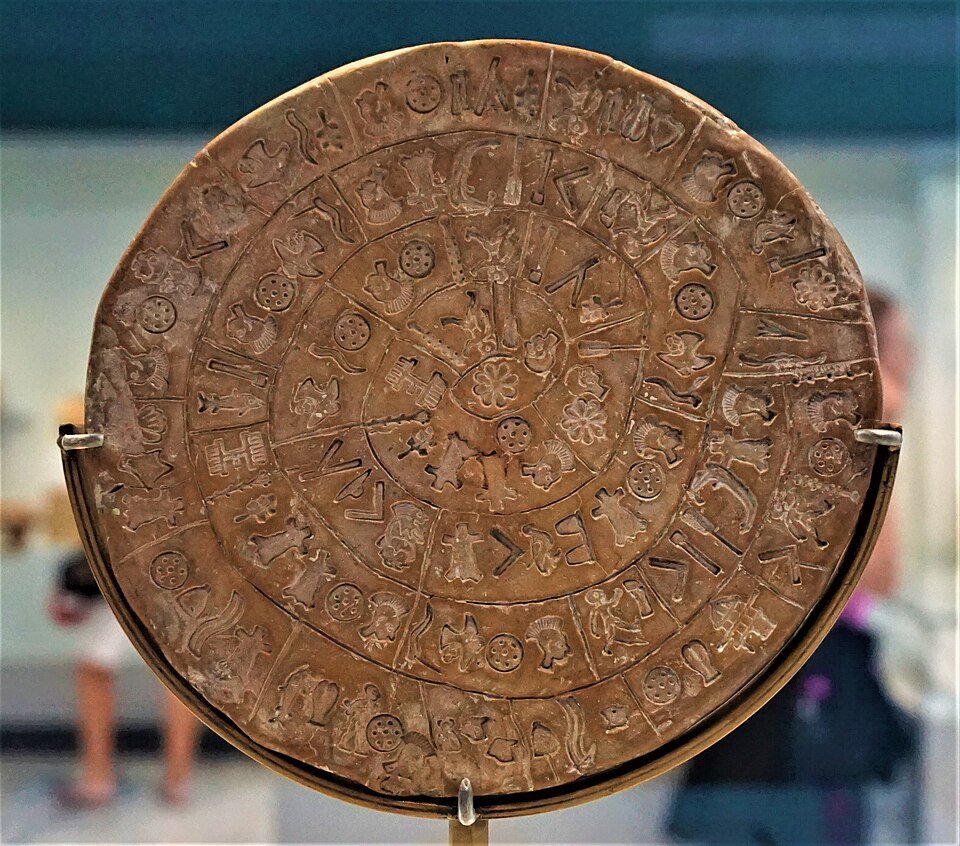
Few ancient objects invite as many confident claims as the Phaistos Disc. The small clay artifact from Minoan Crete carries a spiral of stamped symbols on both sides. Despite more than a century of attempts to read it, scholars have not reached an accepted decipherment.
Its real mystery is not whether the markings are intriguing. It is how anyone can establish what a short and largely unique inscription means without enough comparable texts.
Where Was the Phaistos Disc Found?
Italian archaeologist Luigi Pernier discovered the disc at the Palace of Phaistos on Crete on 3 July 1908. The Heraklion Archaeological Museum dates the object to approximately 1700–1650 BCE, placing it in the Minoan Bronze Age.
The object is now closely associated with the museum’s collections and has become one of the best-known symbols of undeciphered ancient writing.
What Is Written on the Disc?
The markings were not scratched individually in the way one might write with a stylus. Instead, small seals were pressed into wet clay before the disc was fired. This created repeated pictorial signs with unusually consistent forms.
According to the Heraklion Archaeological Museum, the two sides contain 241 signs arranged in 61 groups. The signs include images resembling people, animals, plants, and objects. Their spiral organization makes the disc immediately recognizable.
Why Has Nobody Deciphered It?
There is too little comparative material
Successful decipherment usually depends on repeated texts, predictable patterns, and ideally links to a known language. The Phaistos Disc is unusually difficult because its sequence is short and its sign system is not securely matched to a larger surviving corpus.
The underlying language is uncertain
Researchers have compared its signs with writing traditions such as Cretan Hieroglyphic and Linear A. Similarities can be suggestive, but visual resemblance alone cannot prove that two scripts work the same way.
Almost any proposed reading can sound persuasive
When there is no agreed external test, a proposed translation can be made to fit a preferred narrative. Strong decipherment requires a method other specialists can independently check, not simply a dramatic result.
Was the Disc a Prayer, Hymn, or Story?
The Heraklion Archaeological Museum notes that recurring groups of symbols may resemble a refrain, a pattern consistent with the possibility of a hymn or incantation. That is an interesting interpretation, but the museum also emphasizes that the inscription’s content has not been established definitively.
Suggestions ranging from ritual recitation to administrative record have appeared over time. None should be presented as settled fact without stronger comparative evidence.
Does the Spiral Give Us the Reading Direction?
The inscription runs in a spiral on each face. The museum describes a marker on the outer edge that indicates reading from the outside toward the center. Even when the likely sequence of signs can be studied, however, knowing their order does not tell us their sounds, grammar, or meaning.
What Would It Take to Solve the Mystery?
A securely excavated inscription using the same signs, especially one containing recognizable names or a bilingual text, could substantially improve the odds. New evidence might reveal the script’s relationship to other Aegean writing systems.
Until then, the scientifically responsible conclusion is that the Phaistos Disc is an authentic and remarkable archaeological object with an undeciphered inscription.
Frequently Asked Questions
How old is the Phaistos Disc?
The Heraklion Archaeological Museum dates it to around 1700–1650 BCE.
Is the Phaistos Disc deciphered?
No decipherment has achieved a definitive scholarly consensus.
How many symbols are on it?
The museum counts 241 impressed signs arranged in 61 groups across the two sides.
Continue Exploring
If you enjoy unanswered questions from archaeology, read about the Antikythera Mechanism, an ancient Greek device whose physical function is better understood than the Phaistos Disc’s inscription.