The Terracotta Army: The Incredible Secret Buried with China’s First Emperor
Introduction
The Terracotta Army is one of the greatest archaeological discoveries ever made. Hidden beneath the earth for more than 2,200 years, thousands of life-sized clay soldiers stood silently guarding the tomb of China’s first emperor, Qin Shi Huang.
When local farmers accidentally uncovered fragments of these ancient statues in 1974, they revealed an underground world unlike anything archaeologists had ever seen. Since then, the Terracotta Army has transformed our understanding of ancient China, imperial power, military organization, and funerary traditions.
Today, millions of visitors travel to Xi’an every year to witness this extraordinary site, while archaeologists continue to uncover new secrets hidden beneath the surrounding landscape.
In this article, we explore the remarkable story behind the Terracotta Army, how it was discovered, why it was created, and what scientists continue to learn from one of history’s greatest archaeological treasures.
What Is the Terracotta Army?
The Terracotta Army is a vast collection of life-sized clay soldiers, horses, chariots, and military officers buried near the mausoleum of Qin Shi Huang, the first emperor who unified China in 221 BCE.
Rather than serving on a battlefield, these statues were created to accompany the emperor into the afterlife. Ancient Chinese beliefs held that powerful rulers would continue to govern after death, requiring armies, servants, and valuable possessions in the next world.
Archaeologists estimate that the burial complex contains more than 8,000 soldiers, hundreds of horses, dozens of wooden chariots, musicians, officials, acrobats, and many other figures that formed an enormous underground empire.
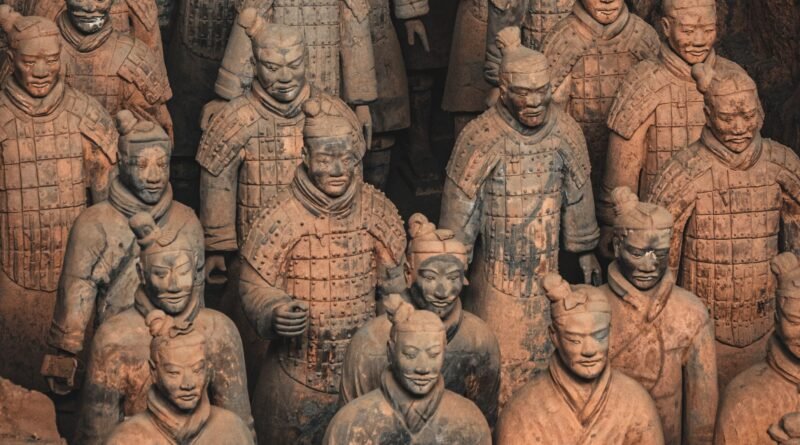
One of the most astonishing discoveries is that no two faces appear to be exactly alike. Each warrior displays unique facial features, hairstyles, expressions, and armor, demonstrating the extraordinary craftsmanship achieved more than two millennia ago.
Who Was Qin Shi Huang?
Qin Shi Huang (259–210 BCE) was the founder of China’s Qin Dynasty and the first ruler to unify the many warring states into a single empire. Before his reign, China consisted of competing kingdoms that fought for power over several centuries during the Warring States Period.
After achieving unification in 221 BCE, Qin Shi Huang introduced sweeping reforms that reshaped Chinese civilization. He standardized the writing system, currency, weights and measures, and road networks, making communication and trade far more efficient across the empire.
The emperor also launched enormous construction projects, including early defensive walls that later became part of the Great Wall of China. Although these achievements strengthened the empire, his rule was also known for harsh laws, forced labor, and strict control over political opposition.
Obsessed with immortality, Qin Shi Huang searched for mythical elixirs believed to grant eternal life. Historical records suggest he sent expeditions across the seas seeking magical islands and consumed mercury-based medicines that may have contributed to his death in 210 BCE.
His desire to rule forever inspired the construction of one of history’s largest burial complexes, complete with an underground army prepared to protect him in the afterlife.
How Was the Terracotta Army Discovered?
The discovery of the Terracotta Army was entirely accidental. In March 1974, several farmers digging a well near the city of Xi’an in Shaanxi Province uncovered fragments of broken clay figures instead of water.
Local authorities quickly realized the importance of the discovery and notified archaeologists. Excavations soon revealed one of the greatest archaeological sites ever found, with thousands of life-sized statues buried in carefully arranged underground pits.
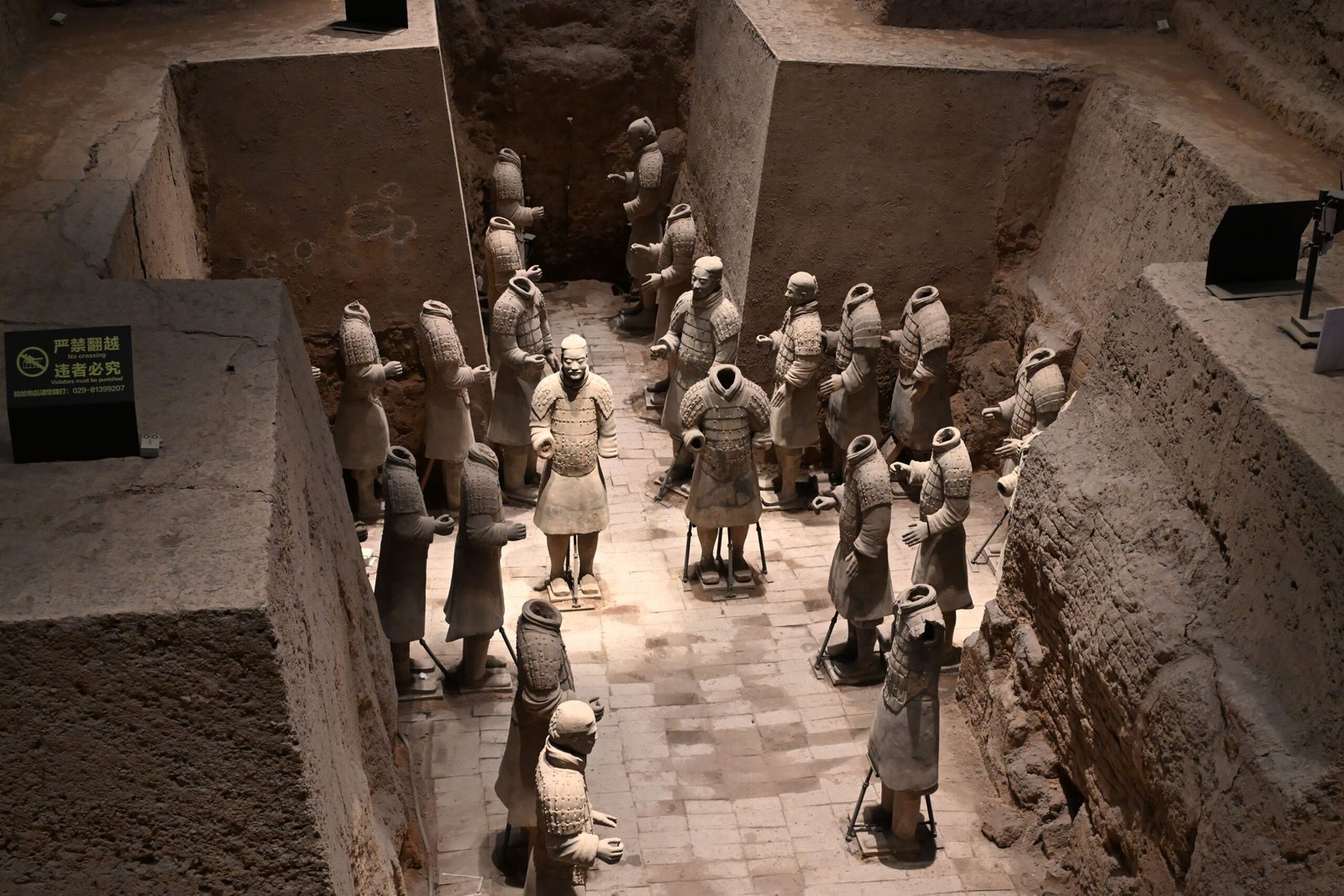
Researchers identified multiple excavation pits, each serving a different military purpose. The largest pit contains the main infantry force arranged in battle formation, while other pits include cavalry units, archers, officers, war chariots, and command personnel.
Excavations continue today, and archaeologists believe that much of the enormous mausoleum complex remains unexplored. Advanced technologies such as ground-penetrating radar and 3D scanning are helping researchers investigate buried structures without damaging the site.
The central tomb of Qin Shi Huang itself has never been fully excavated. Historians believe it may still contain priceless artifacts, but concerns about preservation and the risk of damaging fragile remains have delayed any attempt to open the burial chamber.
How Many Soldiers Were Found?
Archaeologists estimate that the Terracotta Army includes more than 8,000 life-sized soldiers, around 130 chariots, over 500 horses, and approximately 150 cavalry horses. However, these numbers continue to grow as excavations reveal new sections of the burial complex.
The army was carefully organized according to ancient military strategy. Infantry troops occupied the front lines, archers guarded the flanks, cavalry units stood ready to advance, while high-ranking officers commanded the formations. This realistic arrangement demonstrates the Qin Dynasty’s advanced understanding of warfare and military discipline.
Each warrior originally carried real bronze weapons, including swords, spears, crossbows, lances, and halberds. Many of these weapons remain remarkably sharp despite being buried for more than two thousand years.
Why Was the Army Buried?
Ancient Chinese beliefs held that life continued after death. Qin Shi Huang believed he would continue ruling his empire in the next world just as he had on Earth. To protect himself in the afterlife, he ordered the construction of an enormous underground kingdom complete with soldiers, officials, entertainers, servants, animals, and valuable treasures.
Unlike earlier rulers who buried living servants with them, Qin Shi Huang commissioned thousands of clay figures instead. This decision allowed craftsmen to create a permanent army without sacrificing countless human lives.
The emperor’s mausoleum is believed to cover nearly 56 square kilometers, making it one of the largest burial complexes ever built.
Amazing Facts About the Terracotta Army
- No two warriors appear to have identical faces.
- Most statues were originally painted in bright colors including red, blue, green, purple, and black.
- The paint faded rapidly after excavation because of exposure to air.
- Many bronze weapons still retain incredibly sharp edges.
- Each warrior weighs between 100 and 300 kilograms.
- Craftsmen likely used assembly-line production techniques more than 2,200 years ago.
- The burial complex also includes musicians, dancers, acrobats, government officials, and bronze birds.
Scientific Discoveries
Modern technology has dramatically improved the study of the Terracotta Army. Laser scanning, 3D modeling, CT imaging, and chemical analysis allow researchers to examine statues without damaging them.
Scientists discovered traces of colorful pigments on many warriors, proving that the army originally appeared far more vibrant than the gray figures visitors see today. Conservation experts continue developing new methods to preserve these fragile colors immediately after excavation.
Soil analysis around the emperor’s tomb has detected unusually high concentrations of mercury. Ancient historian Sima Qian described rivers of flowing mercury inside the burial chamber, and modern evidence suggests these accounts may contain elements of truth. Because of preservation concerns, the central tomb remains unopened.
Frequently Asked Questions
Where is the Terracotta Army located?
The Terracotta Army is located near Xi’an in Shaanxi Province, China.
Who built the Terracotta Army?
Thousands of skilled craftsmen working under Emperor Qin Shi Huang built the army around 220 BCE.
Why are the soldiers made of clay?
Clay provided a practical and durable material for creating thousands of life-sized figures intended to guard the emperor forever.
Can visitors see the Terracotta Army today?
Yes. The Museum of the Terracotta Army near Xi’an welcomes millions of visitors every year.
Has the emperor’s tomb been opened?
No. Archaeologists have not opened the central burial chamber because current technology cannot guarantee the preservation of its contents.
Conclusion
The Terracotta Army stands as one of humanity’s greatest archaeological achievements. More than two thousand years after its creation, the silent army continues to reveal new insights into ancient Chinese history, engineering, military organization, and artistic excellence.
As technology advances, archaeologists hope to uncover even more secrets hidden beneath Qin Shi Huang’s vast mausoleum. Until then, the Terracotta Army remains a breathtaking reminder of the ambition, power, and extraordinary craftsmanship of China’s first emperor.
If you enjoy exploring remarkable archaeological mysteries, you may also like our article on The Lost City of Atlantis, where we examine another legendary civilization that continues to fascinate historians and explorers alike.