Roman Dodecahedron Mystery: What Were These Objects For?
Across parts of northwestern Europe, archaeologists have uncovered a curious Roman-period object: a hollow, twelve-sided metal form with a circular opening in each face and small knobs at its corners. These objects are known as Roman dodecahedrons, and their original purpose remains uncertain.
The mystery is not that the Romans could make them. Roman craftspeople were highly skilled metalworkers. The difficult question is why this particular design was produced, and why no surviving Roman text clearly explains its function.
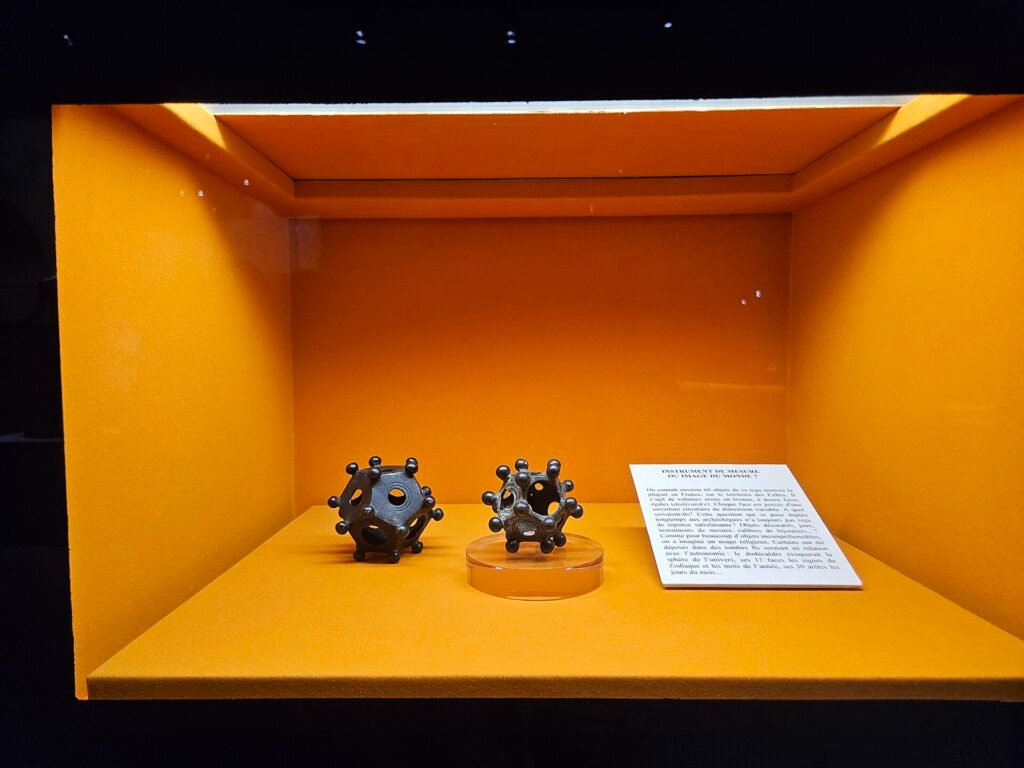
Image: Roman dodecahedron photographed by John Samuel. Source: Wikimedia Commons. Licensed under Creative Commons Attribution-ShareAlike.
What Is a Roman Dodecahedron?
A Roman dodecahedron is usually made from copper alloy and has twelve pentagonal faces. Many examples feature holes of different diameters, while the corners are capped with rounded projections. Their dimensions vary, so it is unlikely that every example could have served as a perfectly standardized measuring instrument.
These objects are most strongly associated with the northwestern provinces of the Roman world. Their distribution has led researchers to ask whether they belonged to a regional custom rather than to everyday Roman life throughout the empire.
The Norton Disney Discovery in England
One of the most striking discoveries came from Norton Disney in Lincolnshire, England. Volunteers uncovered a remarkably complete dodecahedron in 2023. Lincolnshire County Council reported that the copper-alloy object measured roughly 8 centimetres in height and weighed around 245 grams. It was displayed publicly in 2024.
The find provided an unusually intact specimen and brought fresh attention to the puzzle. However, an excellent state of preservation does not by itself establish a particular use. Its archaeological context still needs to be considered alongside comparable finds.
What Were Roman Dodecahedrons Used For?
Measuring or surveying tools
One popular proposal is that people looked through pairs of differently sized openings to estimate distances. The shape makes this imaginable, but the theory faces a major challenge: the holes and dimensions are not uniform across known examples, and there is no surviving instruction describing such a method.
Craft or textile equipment
Another modern theory proposes that dodecahedrons helped make gloves or other knitted items. Demonstrations can show that an object might be usable for a task, but this does not prove that ancient people actually used it that way. Archaeological wear patterns and contextual evidence would be needed.
Ritual or symbolic objects
Some researchers and local archaeological groups consider a ritual function plausible. This interpretation fits the absence of an obvious practical design standard, but it, too, remains a hypothesis. Calling something ritual should not become a substitute for explaining how the evidence supports that conclusion.
What Does the Evidence Actually Tell Us?
Three observations are particularly important. First, Roman dodecahedrons are genuine ancient objects, not modern inventions. Second, their construction shows technical skill. Third, neither their physical form nor the currently available written evidence provides a conclusive explanation for their use.
Archaeology often works with probabilities rather than definitive answers. Researchers compare findspots, manufacturing techniques, damage patterns, and associated objects. A strong interpretation must account for many examples, not merely show that one specimen can be used in an ingenious modern experiment.
Why the Mystery Matters
Roman dodecahedrons are a reminder that even a literate and extensively studied civilization can leave behind objects whose meanings have been forgotten. They also illustrate why it is important to distinguish what was found from what we think it was for.
Rather than presenting one fashionable theory as the answer, the most accurate conclusion is simple: the objects are real, the theories are interesting, and their function has not been established.
Frequently Asked Questions
Are Roman dodecahedrons real?
Yes. Archaeologists have recorded multiple examples from Roman-period sites, including the well-preserved Norton Disney specimen.
Were they used as weapons?
That has been proposed, but no persuasive consensus supports a weapon function.
Why are they found mostly in northwestern Europe?
The distribution suggests a regional tradition, but its cultural meaning remains uncertain.
Continue Exploring
Interested in other disputed ancient technologies? Read The Baghdad Battery and The Antikythera Mechanism.